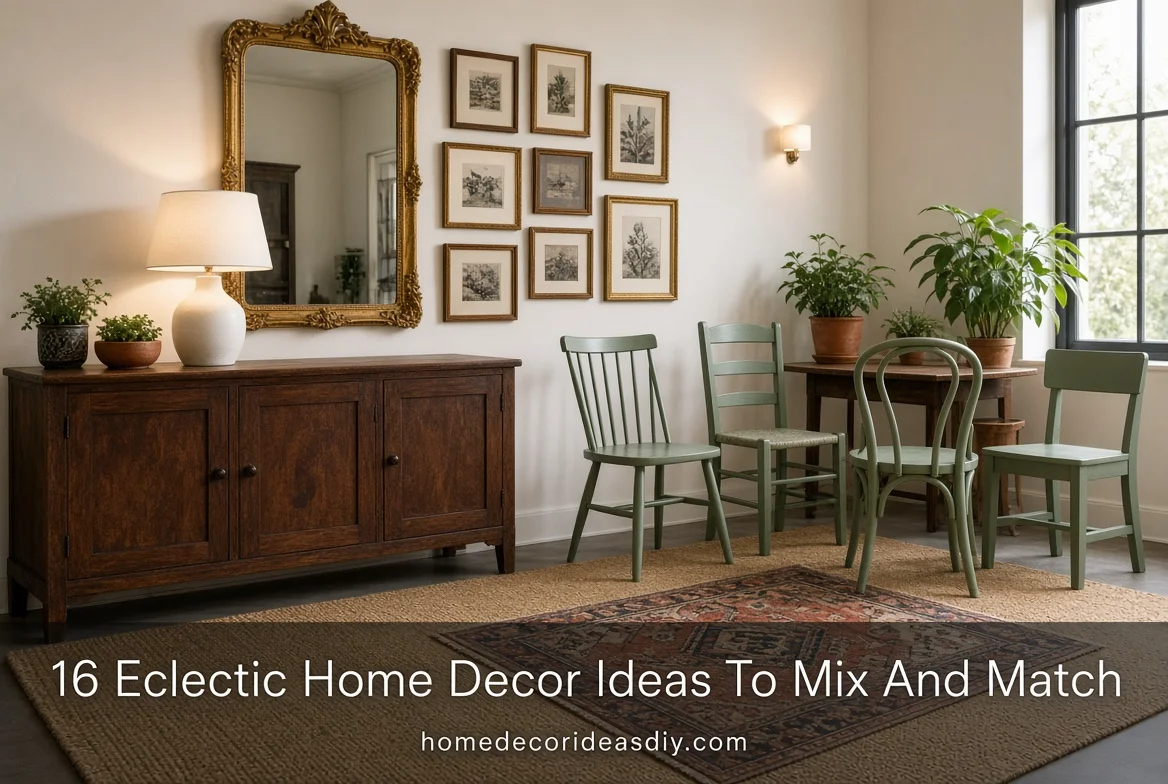
Your nan’s teak sideboard, an IKEA sofa, a gilt mirror from the charity shop and a rug off Facebook Marketplace can easily add up to a house clearance rather than a style. The fix is rarely buying more. Eclectic home decor ideas work when the pieces differ in age and shape but share one thing you repeat on purpose: a colour that turns up at least three times, a single wood tone, one metal finish, or a line the eye can follow. Mix the styles. Repeat the thread.
The sixteen below go from ten-minute jobs to a couple that will eat a weekend.
Eclectic home decor ideas fall apart when nothing in the room repeats.
Eclectic interior design gets mistaken for clutter because both involve mixing things. The difference is whether your eye can find a route round the room. If the rust in a cushion shows up again in a vase and again on the spine of a book, the mix reads as chosen, and if every object brings its own colour and its own finish, it reads as stuff.
Most of the ideas below are ways of planting that repeat without making the room match. Matching is the other way to fail. Buy everything in one colour, and you have a showroom.
1. Paint four odd dining chairs the same colour
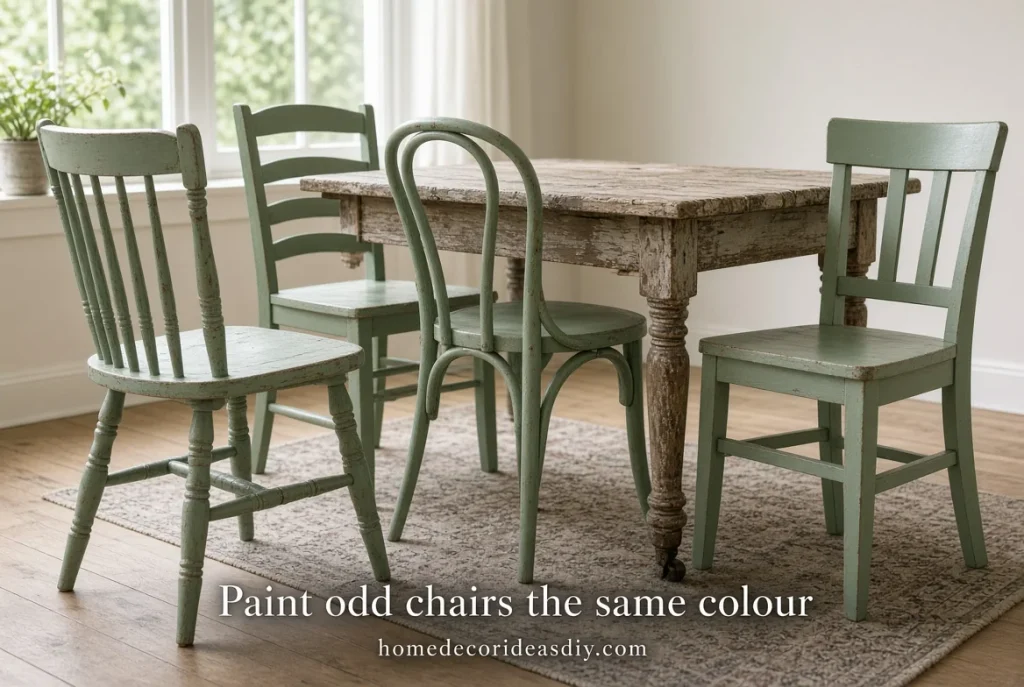
A spindle back, a ladder back, a bentwood and one plain kitchen chair look like a set once they share a colour, and they keep the shapes that made them worth buying in the first place.
Order of work:
- Wash with sugar soap first. Kitchen chairs carry years of grease you can’t see, and paint won’t grip it.
- Key the surface with a medium sanding sponge. You’re dulling the shine, not stripping it.
- Prime with whatever suits the wood underneath (idea 4 covers which one).
- Two thin coats. A thick one sags in the spindle joints and dries into drips you’ll find later with your thumb.
- Chalk paint on anything you sit on needs wax or lacquer over it, or it scuffs fast.
Bentwood is fiddly with a brush. Spray is quicker, if you can do it outside on a still day.
2. Keep to one wood tone per room, or two that are far apart
Honey pine next to orange teak is the combination that looks accidental. Both mid-tone, both warm, and they argue. Pale oak beside dark walnut reads deliberate because the gap is obvious. If you can’t lose the pine, paint it and keep the teak.
3. Hang mismatched frames with matching mounts
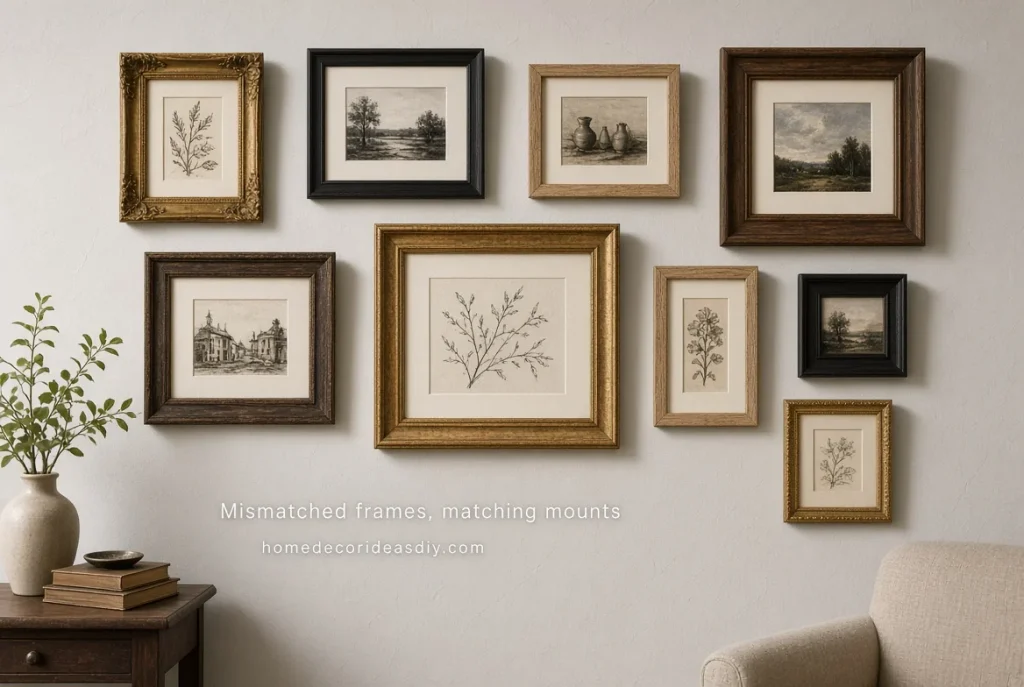
Charity shops are full of frames, and the glass alone is often worth what you pay. Keep the frames different (gilt, black, raw wood, one chunky one) and put a white or off-white mount in every single one. The mounts do the repeating, so the frames can clash.
Before a nail goes in, trace each frame onto paper (lining paper is ideal), cut the shapes out and stick them up with low-tack masking tape. Live with it for a couple of days. Mark the hanging point on each template, nail straight through the paper, then tear it away. A strip of card cut to your chosen gap works as a spacer and saves a lot of squinting.
I’d skip gold spray on raw wood frames. It looks cheap in daylight and picks out every grain line.
4. Paint the brown furniture, but find out what’s underneath first
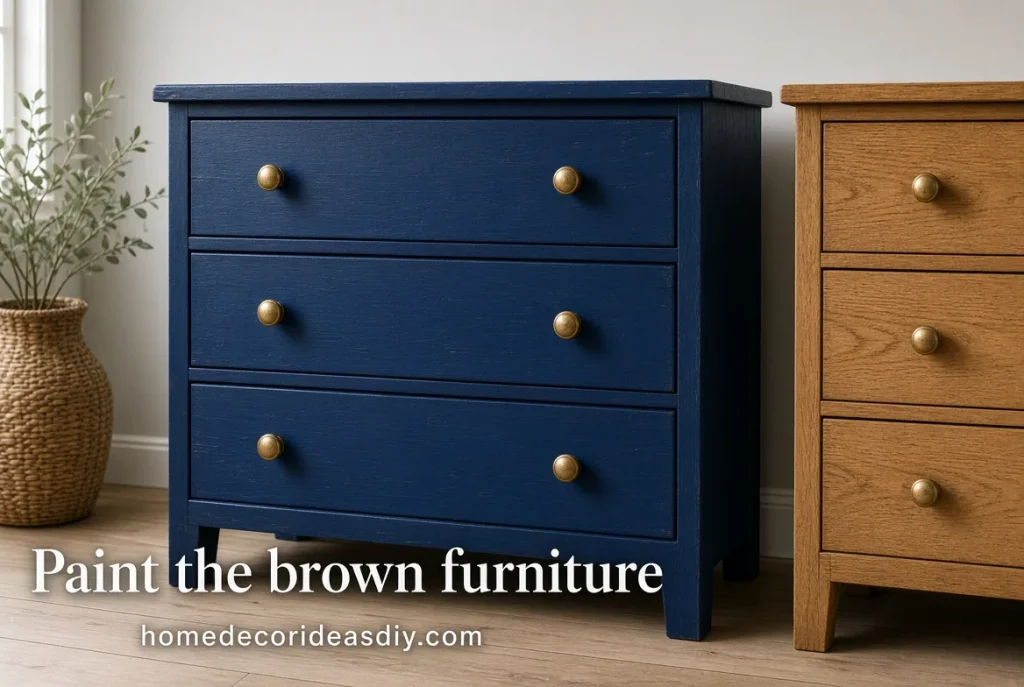
This is the one to do if you want eclectic style on a budget, because a solid 1970s chest of drawers from a charity shop usually costs less than flat-pack and will outlast it. The catch is the surface. Each finish fails in its own way:
| Knotty pine | Knots bleed yellow-brown through pale paint, sometimes weeks later | Seal each knot with knotting solution or a stain-blocking primer |
| Mahogany or dark varnished wood | Tannin bleed turns white paint pink or brown | Stain-blocking primer, two coats on the worst areas |
| Laminate or melamine | Paint lifts off in strips under a fingernail | Key it hard, then a bonding primer |
| MDF edges | Cut edges drink the paint and stay furry | Prime, sand smooth when dry, prime again |
| Old painted pieces | Lower layers may contain lead | Don’t dry sand (see below) |
That last row matters more than the rest. Most paints used lead pigments in the 1960s, and wood painted before then can still contain significant lead in its older coats. Dry sanding turns it into dust you breathe, and your kids crawl through. The British Coatings Federation’s guidance on lead in painted surfaces covers testing and safer methods, and it’s worth ten minutes before you touch an old dresser with a sander, especially if anyone pregnant or small lives with you.
Get it right, though, and one painted chest in a strong colour can carry a room.
5. Put a modern lamp on an old sideboard
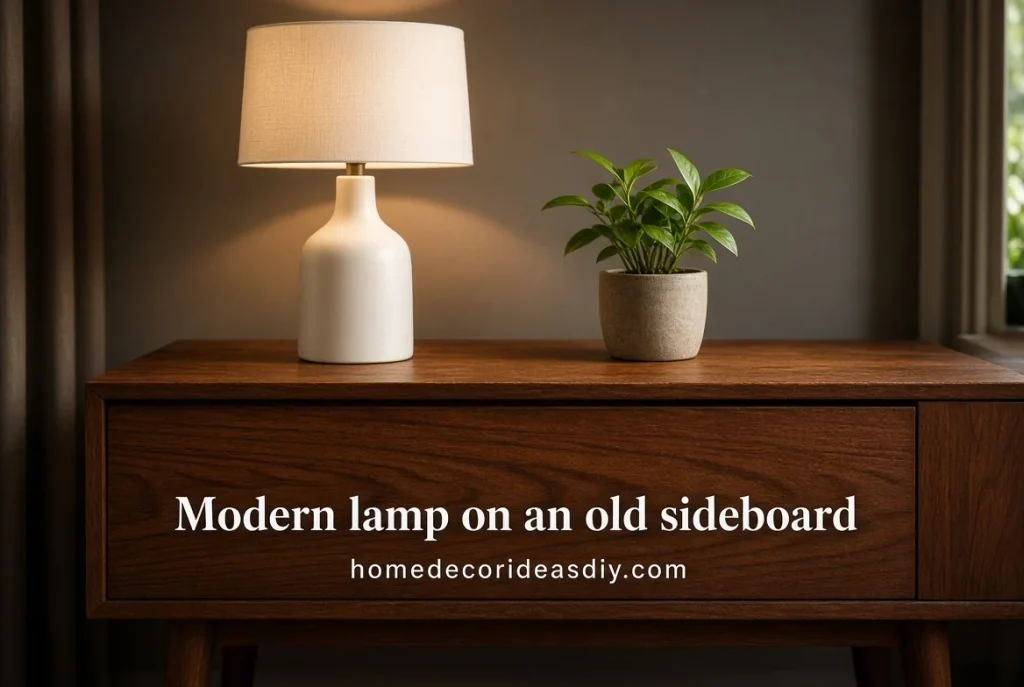
Old base, new light. A plain glass or white ceramic lamp on a dark 1950s sideboard does more than a matching period lamp ever would.
6. Mix patterns by size, not by colour
Most people mixing patterns choose fabrics that are all medium-sized, which is exactly what makes a room busy. Go for one large pattern, one medium, one small: a big floral curtain, a striped or checked cushion, a tiny print on a lampshade. Then make sure one colour runs through all three. It can be a minor colour in the big print. That’s usually better, as it pulls the eye into the detail.
Floral next to geometric is fine. Two large florals at the same scale aren’t.
7. Paint the alcoves, not the whole room
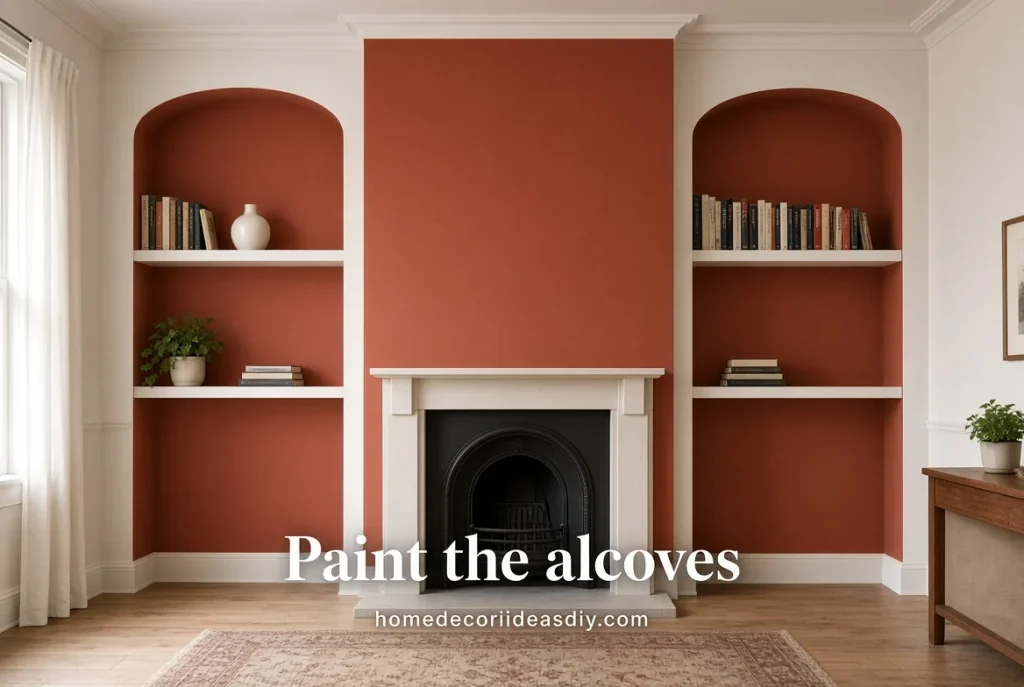
In most terraces and semis, the chimney breast has an alcove on either side, and they’re the cheapest place to try a strong colour. Two small walls, one evening. It’s one of the easier eclectic living room ideas because the alcoves already frame whatever sits in them, so a mixed collection on shelves in there looks placed rather than dumped. Cutting in is the slow bit: brush the line where wall meets ceiling first, then roll the middle while that edge is still wet, because if the edge dries first you get a visible band, and touching up a missed patch later with a roller can leave flashing, a shinier patch where new paint sits on old, which is worst on matt and usually means redoing the whole wall corner to corner (some chalky matts forgive it, most don’t). Paint the skirting in the alcove to match? Lovely in a dark shade. In a pale one, it tends to look like you ran out of time.
8. Swap every handle for one metal
A pine chest, a painted bedside table and a secondhand wardrobe all wearing the same aged brass knobs start to look related. Measure the screw centres on any two-hole handle before ordering. Old drawers often don’t match what’s sold now, and filling and redrilling is a bigger job than it sounds.
9. Style shelves in odd groups and leave gaps
Threes and fives, heights varied. Books laid flat make a plinth for a small object. Leave a stretch of empty shelf, which is the part everyone skips.
10. Layer a small patterned rug over a big plain one
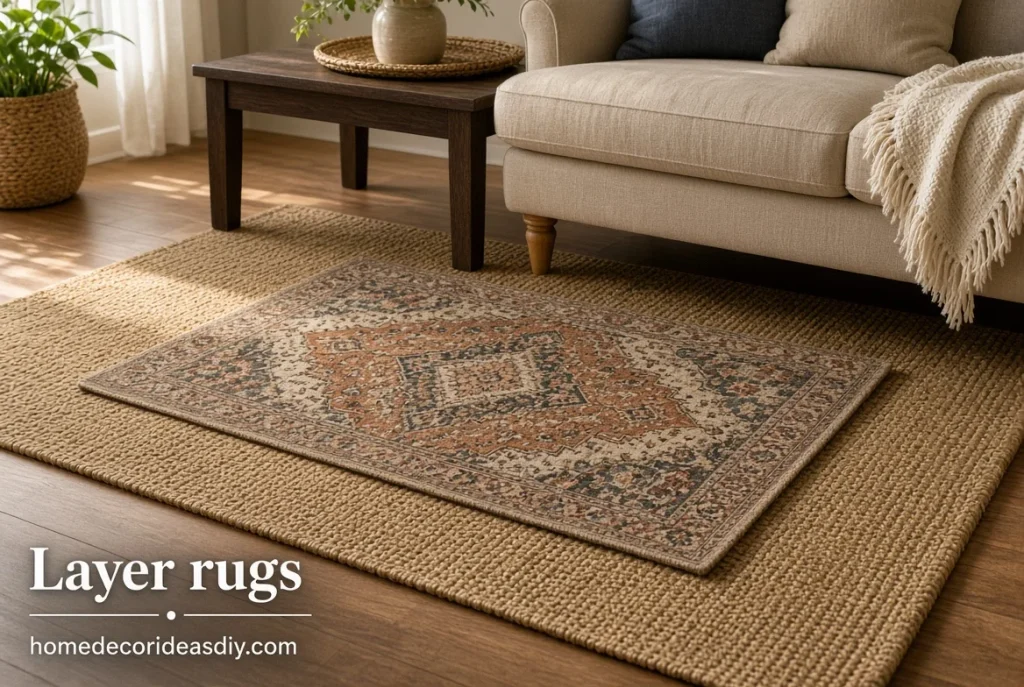
A vintage-style rug looks lost on laminate on its own. Put it on top of a larger jute or plain wool rug, and the plain one sets the edges of the seating area while the pattern gets to be the loud thing.
11. Recover a drop-in seat pad in a fabric you’d never put on a wall
Most old dining chairs have seats that push out from underneath. Lever out the old staples with a flat screwdriver, use the old fabric as a pattern and leave enough extra to pull underneath. Staple from the middle of each side towards the corners, then fold the corners like wrapping a present. A seat takes very little fabric, so the remnant bin is your friend. If your walls are plain, this is where the bold pattern goes.
12. Give a new-build room one piece with real wear
White walls and grey carpet are hard to mix against because nothing has any age. One old thing with genuine scuffs (a school chair, a battered trunk, a mirror with foxed glass) does more than five new pieces sold as “vintage look”.
13. Hang odd plates on the kitchen wall
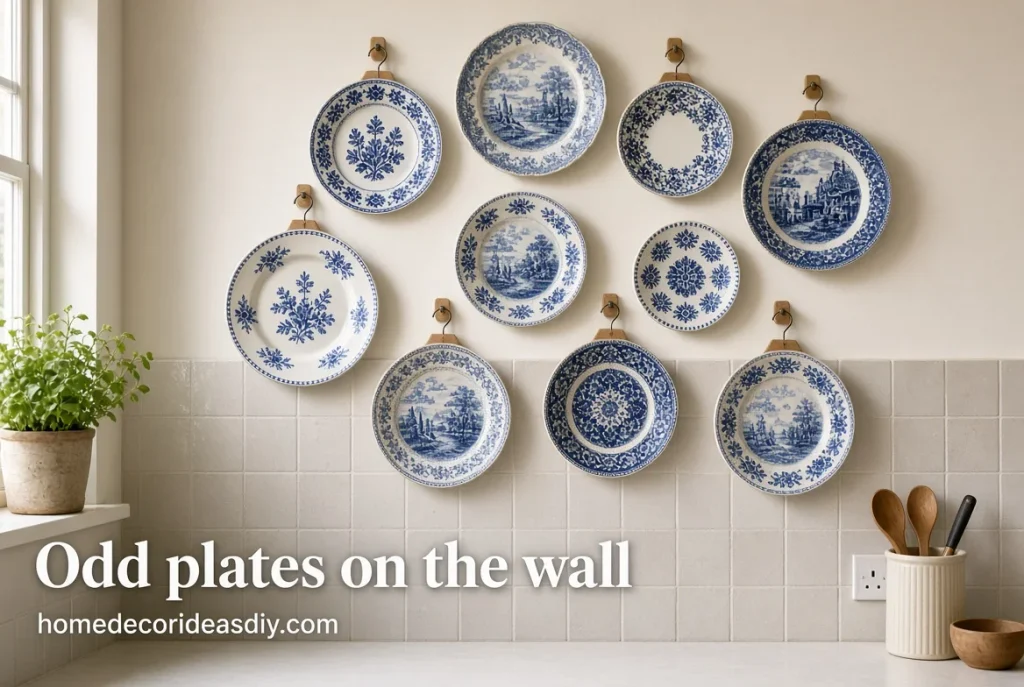
Mismatched charity shop plates, one colour family (blue and white is the easy one), on spring or adhesive disc hangers. Check the hanger is rated for the plate’s weight. Heavy stoneware drags the cheap ones off.
14. Let plants be the green that repeats
In a room with no other plan, green in three or four places does the job on its own. Mixed pots can clash. Terracotta calms them.
15. Put the same bulb in every lamp
Different lamps are fine. Different bulbs aren’t. A cool white bulb in one lamp beside a warm white in another makes the whole room feel off, and you won’t always work out why. Pick one warm white bulb and use it everywhere: ceiling, table and floor—light at three heights too, instead of leaning on the pendant.
16. Take a third of it away for a fortnight
Box up a third of the small things for two weeks. Whatever you missed goes back out. The rest can go to the charity shop you bought it from, which feels about right. Most mixed rooms that don’t work have too much in them, and no amount of repeating colours fixes that.
FAQ
What’s the difference between eclectic and bohemian?
Bohemian is a set look (rattan, macramé, lots of plants, layered textiles, earthy colours), while eclectic is a way of mixing any styles. A Victorian chair with a chrome lamp and not a scrap of rattan can be eclectic. It can’t really be boho.
Is eclectic the same as maximalist?
No. Maximalism is about quantity and saturation. An eclectic room can be quite sparse; three pieces from three different decades in a plain room still count.
What colours work for an eclectic style?
Any, as long as you pick one lead colour and one accent and let everything else be wood or neutral. Deep green, rust and inky blue are forgiving because they sit well with both old wood and modern metal.
Can you do eclectic in a rented house?
Yes, if you keep it to things you can carry out: rugs, lamps, frames on a picture ledge, furniture you own, and paint you can paint yourself. Leave the alcove painting until the landlord has said yes in writing.
Start with the room that bothers you most and look for what already repeats in it, even if it’s two cushions and a book spine. Build from that rather than a shopping list. There are more low-cost room projects on the Home Decor Ideas DIY.