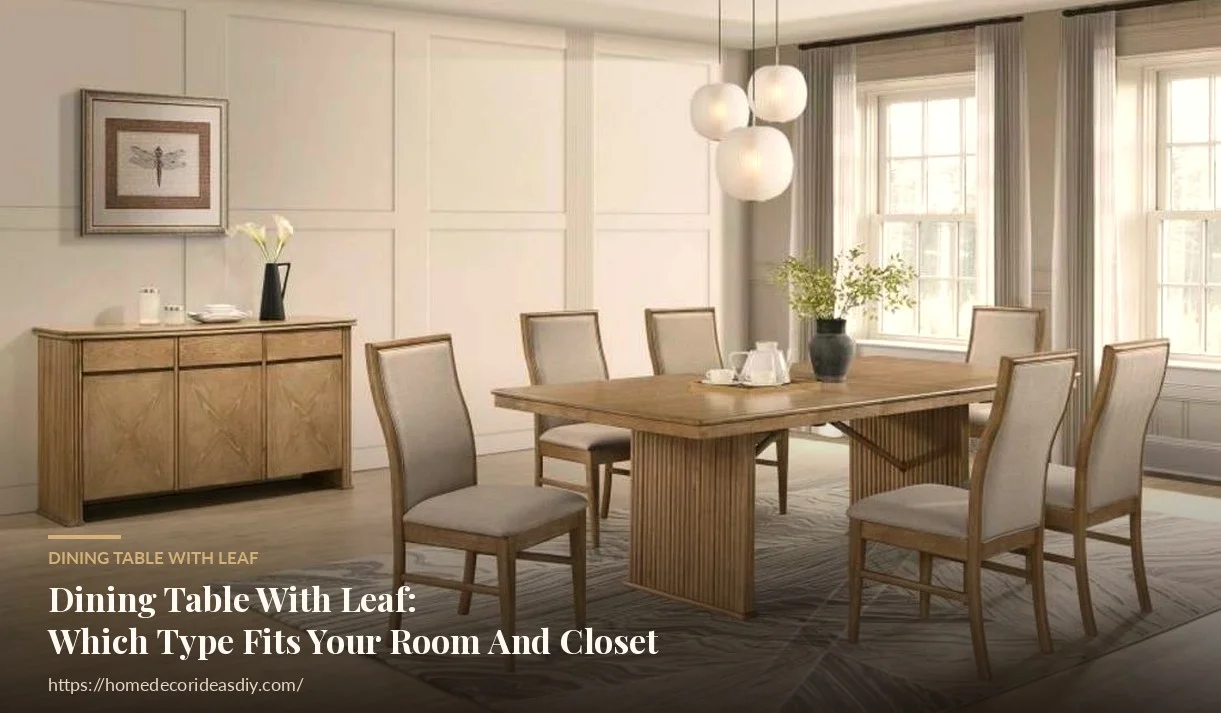
Most people choose a dining table with a leaf in the wrong order. They choose the finish first, then the shape, then whatever extension the store has in stock, and the leaf becomes something to sort out after delivery. Then delivery happens, and a forty-pound board of oak ends up in the hallway with nowhere to go. I’ve watched this play out enough times that I now ask people about closet space before I ask what wood they like, which is an odd thing to begin with, but it saves a lot of irritation six months down the line.
The leaf is what decides the rest.
A Dining Table With Leaf Gains Length, Never Width
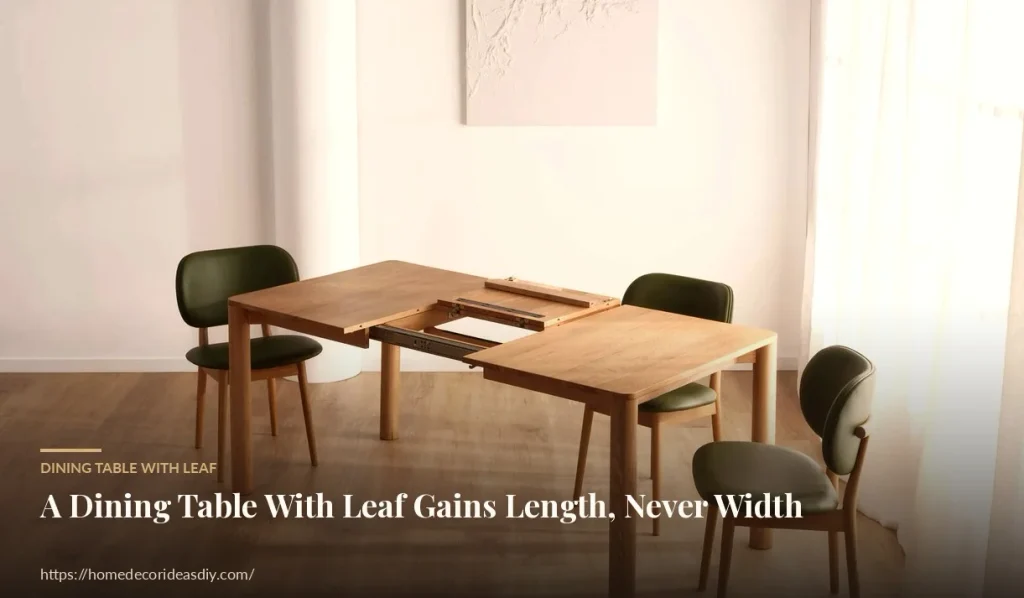
Something that catches buyers constantly extension leaves lengthen a table, they never widen it. A 36-inch-wide top stays 36 inches wide with every leaf in the world dropped into it. What changes is the run. Most removable leaves add 12 to 24 inches each, so a 60-inch table lands somewhere between 72 and 84 inches with one leaf seated in the middle.
Seating math is easier than it looks. Allow roughly 24 inches of table edge per person and count the perimeter. That 60-inch table takes six at a squeeze and eight once the leaf goes in, fewer if your chairs have arms, and arms eat more room than anyone expects them to.
Clearance is the number people skip. You want about 36 inches between the table edge and the wall so chairs can be pushed back without somebody doing the sideways shuffle past the radiator, and you measure that against the extended length, not the closed one. A table that fits beautifully at 60 inches and blocks a doorway at 84 is still a table that doesn’t fit.
Four Leaf Types You’re Choosing Between
Center or drop-in leaves are the traditional setup. The table splits down the middle you lift a board into the gap, and the ends stay exactly where they were. They usually run 12 to 18 inches wide; you can stack two or three if the slides allow it, and nothing mechanical goes wrong because there is nothing mechanical. The catch is that the board lives somewhere else for most of the year.
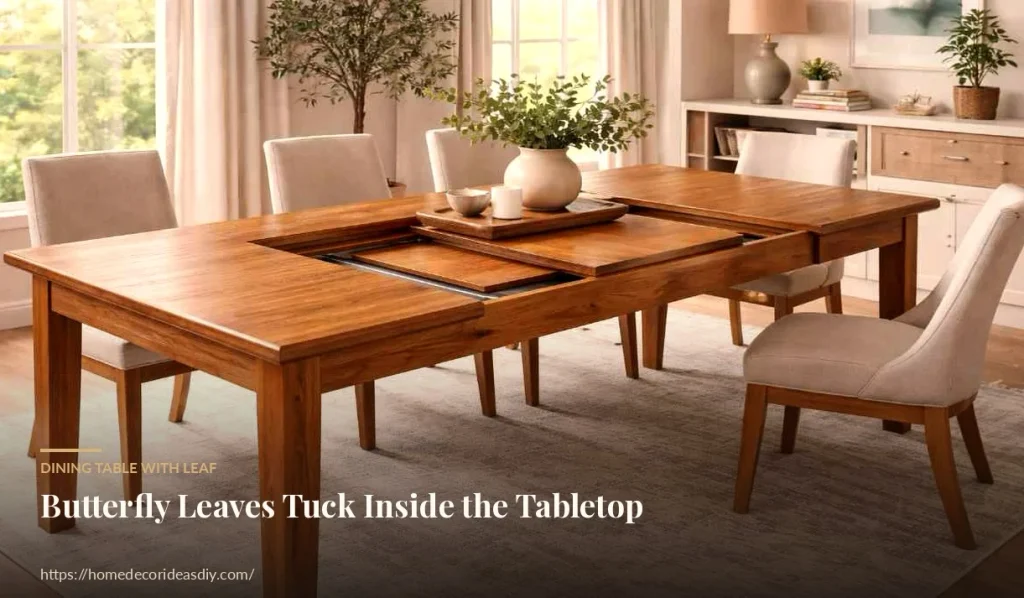
Butterfly leaves fold in half on a hinge and tuck inside the tabletop, which is the entire appeal. Pull the halves apart, lift the folded leaf out of its pocket, open it flat, push the table back together one person, thirty to sixty seconds. No closet needed. The trade-off is size, because a self-storing leaf has to fit inside the table it belongs to, so you get one, and it sits at the smaller end of the range.
Drop-Leaf Tables Are A Different Animal
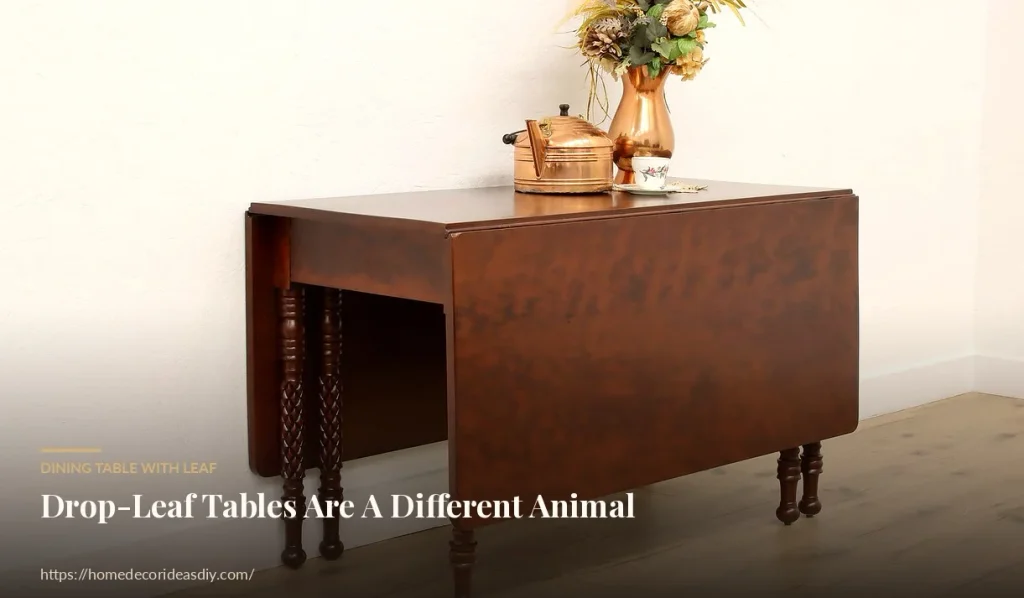
A drop-leaf table has hinged sections on either side of a fixed center that fold straight down, held up when raised by a bracket or by legs that swing out, in the gateleg version. The design traces back to late sixteenth-century England and Elizabethan examples are still knocking about, so it has earned its place.
Folded down, some of these come in at 10 to 20 inches deep, narrow enough to sit flat against a wall in a studio apartment. That’s the argument for them. Against them: sitting at the end of a drop-leaf with the leaves down puts a hinge line under your plate, and the fixed center section on a small one is genuinely tight for four.
Draw leaves, sometimes sold as refectory tables, keep their extensions hidden under the top and pull out from each end. Amish shops still build them with leaves up to 20 inches per side. Nothing to carry, nothing to store, though the longer tops often want two people to open cleanly.
Round Tables Only Self-Store One Leaf
Round tables are where the numbers get odd. A round top has to be 66 inches across or more to seat six comfortably, which is a lot of table for a normal room. But a 48-inch round with a 12-inch leaf opens into a 48 by 60 oval and seats those same six, in a space where a 66-inch circle would be ridiculous.
Round leaves hinge and fold in half to store inside the top, same principle as the butterfly. Most tables will only swallow one that way. Order two and the second one is going in a cupboard.
Where The Leaf Lives For The Other Fifty Weeks
This is the part that goes wrong, and it goes wrong quietly.
Store it flat. Not leaning against a wall, not standing upright behind the winter coats, flat, resting on its largest face. A leaf left on its edge for a couple of years will bow, and a bowed leaf stops dropping into the table properly. It sits proud on one side and rocks whenever somebody leans on it.
Can you keep it in the basement? No, and this is the single most common mistake. Damp does the same work as gravity, slower and far less reversible. Attics and garages swing too hard on temperature, and wood that dries right out shrinks enough to leave a seam you could lose a fork in. Under a bed, in a closet, in roughly the same air as the table itself. If there is no space anywhere in the house for that, you want a self-storing mechanism, and you should stop looking at removable leaves now, rather than after you have paid for one.
Padded leaf bags are made for this, around fifty-one by twenty-eight inches for a standard board, and they cost very little next to the table. An old bed sheet does most of the same job provided the wood can still breathe.
The Leaf And The Table Stop Matching
This one surprises people three or four years in.
Wood in daylight shifts color. Cherry darkens, oak ambers, and most finishes shift under UV, whether or not you notice it day to day. A leaf sitting in a dark closet doesn’t age alongside the table, so you pull it out for a dinner party, and there’s a visibly different stripe running down the center of your table. It reads like a repair. Cherry and walnut are the worst offenders.
Two fixes exist, and neither is thrilling. Leave the leaf in permanently, which cancels half the reason for buying an extendable dining table in the first place. Or rotate it: slot it in for a few weeks twice a year, and shift the runner and the centerpiece about so the top isn’t tanning in one fixed pattern either. Furniture forums have been repeating this advice for well over a decade, and it is still the complaint I hear most often about extension tables.
Buying Secondhand Means Checking The Leaf First
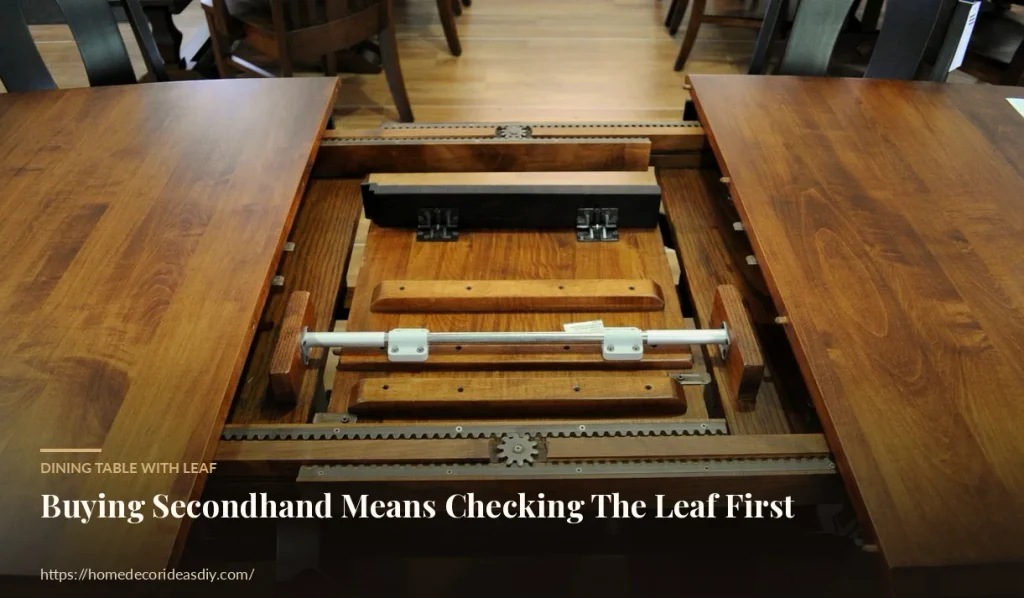
An old extension table is one of the better antique furniture buys around, because the joinery on pre-war draw-leaf and gateleg tables tends to beat what the same money buys new. Check the slides before you look at anything else. Open and close the table twice in front of whoever is selling it. If the halves refuse to meet flush, or one side lifts as it closes, the wooden slides have worn or swollen, and that is shop work rather than a weekend job.
Then ask whether the leaf it comes with is the original leaf. Estate sale tables get separated from their extensions all the time, and a replacement board cut to fit will never quite match the grain or take the stain the same way.
If I had to choose blind on someone’s behalf, I’d take a butterfly leaf over a removable one nearly every time, even though the removable option hands you more table. An extra eighteen inches counts for very little if the board spends nine years in a garage and comes out the wrong color. Convenience wins this argument, and I say that as somebody who usually thinks convenience features on furniture are money thrown away.