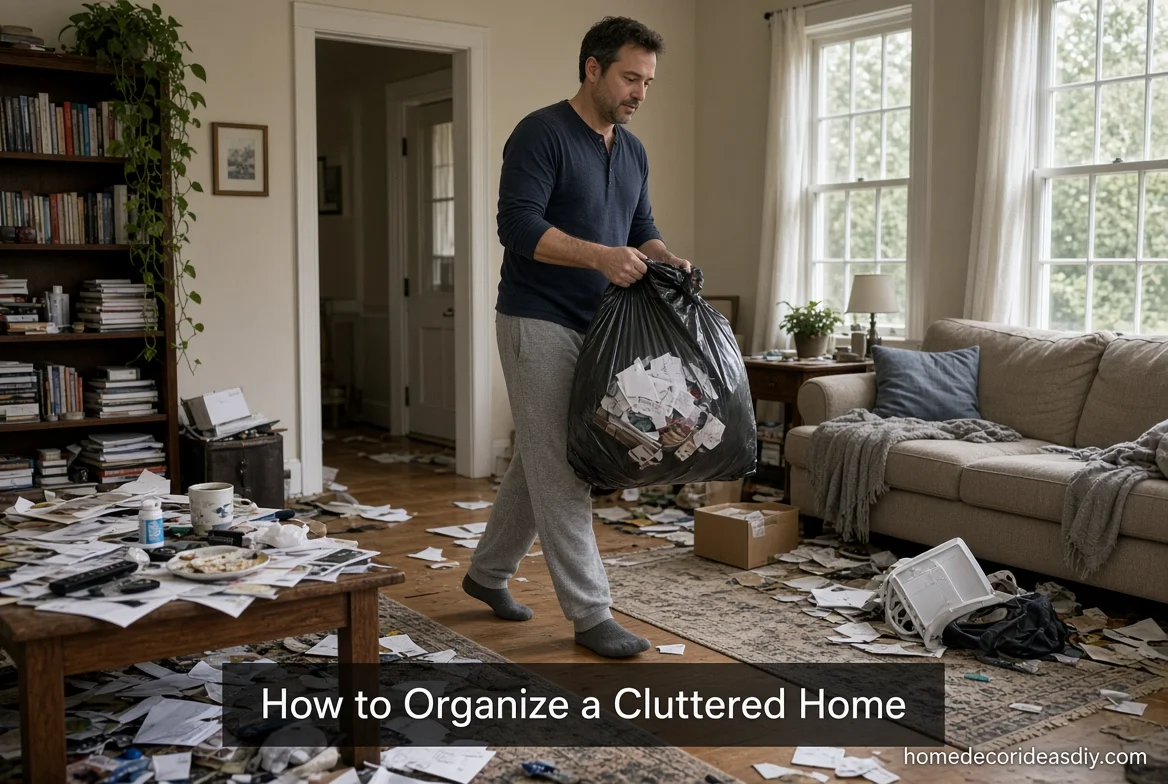
When a house gets really cluttered, the worst part is not knowing where to start, because every room looks about the same. You pick something up, look at it, put it back down, and then check your phone. Most advice on how to organize a cluttered home skips right past that stuck feeling and jumps straight to bins and labels, like shopping for a new closet before you’ve looked inside the old one.
What helps more is going in order, starting with the easiest thing, and the easiest thing in any messy house is the trash. So that’s where this starts. The hard stuff, like the box of old birthday cards and the gift you never liked, comes near the end, once you’ve already got a few wins under your belt.
Walk Through Every Room With A Trash Bag First
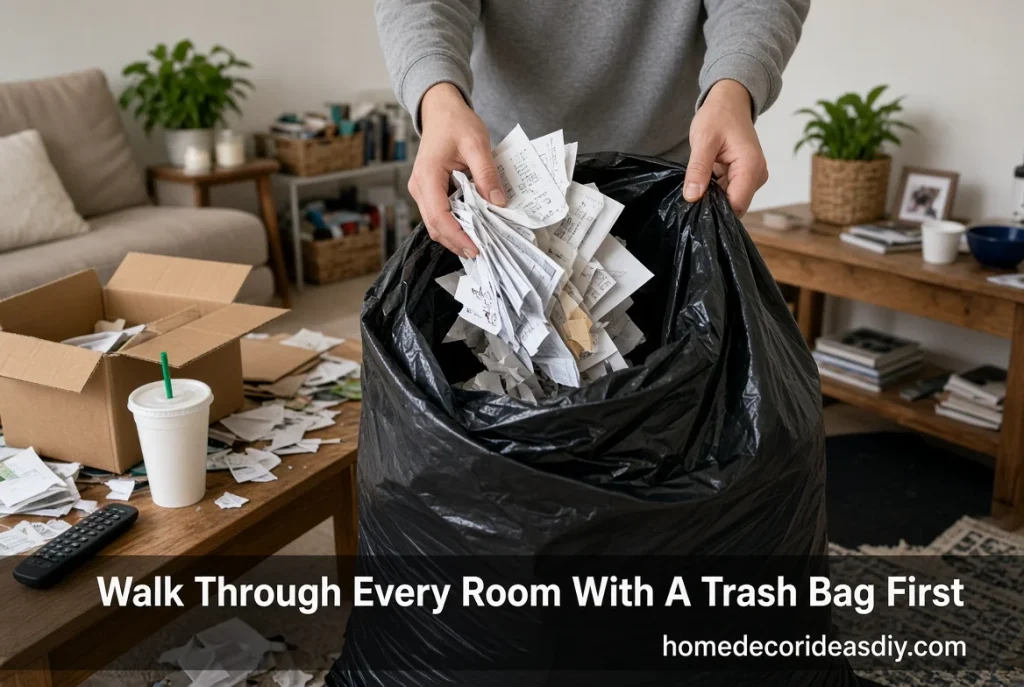
Grab a big trash bag and a second bag for recycling, then walk the whole house picking up only garbage. Junk mail, receipts, empty boxes, pens that don’t write, the takeout cup that’s been on the nightstand since Tuesday. Don’t stop to sort anything else, don’t put anything away, and leave the drawers closed for now.
It sounds too simple, but there’s a reason it goes first. Trash doesn’t make you decide anything, so you can do it even on a tired day, and by the time the bag is full, you’ll see a change in every room. That little “okay, it’s already better” feeling is what gets you to the next step.
Decluttering author Dana K. White starts her method the same way. One of her bigger ideas is to decide on each thing right then, instead of making keep and toss piles that sit around if you get pulled away halfway through. I think she’s right, because a half-sorted pile in the middle of the floor is honestly worse than where you started.
Put Away Anything That Already Has A Home
On the next pass, look for things that already have a place in the house but are sitting in the wrong room. The scissors that belong in the kitchen drawer. Shoes in the living room a bath towel on the couch.
Take each thing to its spot right away, even if it means walking back and forth a lot. I know it feels slow. But if you toss it all in a basket to deal with later, the basket ends up at the bottom of the stairs for a week and becomes one more pile.
If you can’t think of where something goes, leave it where it is. That’s a different kind of problem, and it gets handled further down.
Fill A Donate Box With The Stuff You Won’t Miss
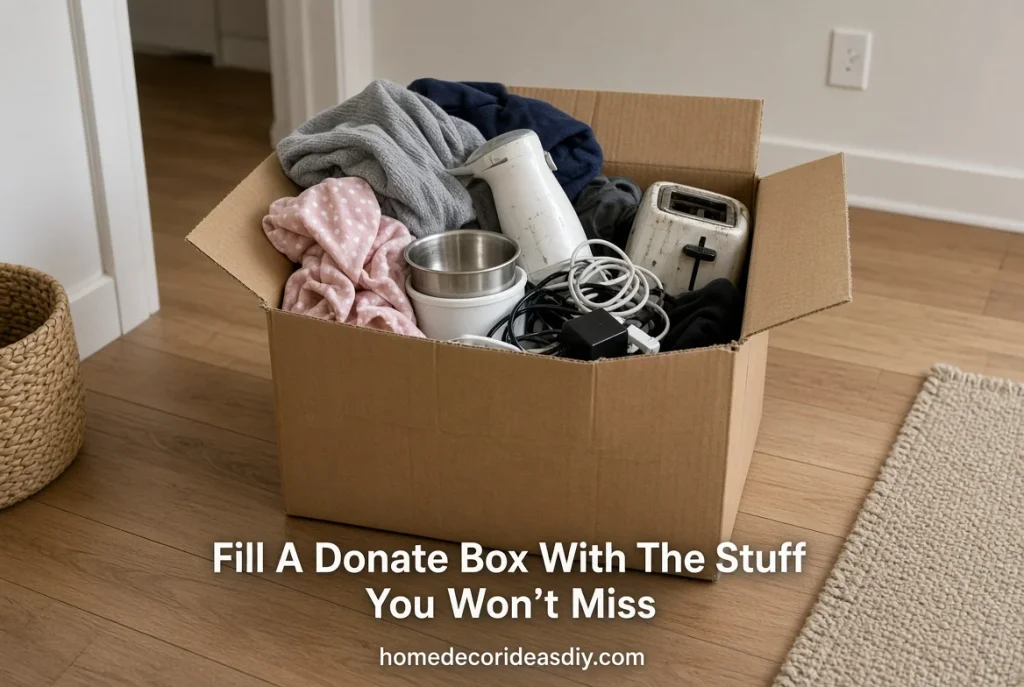
Now get a box and go after the things you already know you don’t want. Keep it to the easy ones for now, things like:
- Duplicates, like the third can opener or the phone charger that doesn’t fit anything you own anymore
- Clothes that don’t fit and haven’t in a while
- Toys and clothes the kids have grown out of
- Broken things you were going to fix someday
When the box is full, put it in your car trunk. I mean that. If it goes in the garage or the hall closet, it will still be there in March.
What about stuff you might need someday? Ask yourself if you’d even remember you own it when that day comes. If the honest answer is that you’d buy a new one anyway, keeping it doesn’t save you anything it just takes up room.
Leave Sentimental Things And Gifts For The End
This is where people get stuck, and it makes sense. Old cards, kids drawings, your grandma’s dishes, the expensive blender you used twice. Most of it isn’t about the object it’s about a person, the money, or who you thought you’d be when you bought it.
A few things that make it a little easier:
- Give keepsakes a limit. One box per person in the house is a good size, and when it’s full, adding something new means picking something to take out.
- Take pictures of the big stuff. A photo of a science fair project keeps the memory and frees up a whole shelf in the closet.
- Let gifts go without the guilt. Whoever gave it wanted you to be happy, and if it sits in a cabinet making you feel bad, that’s not what they had in mind either.
- The money is already spent whether the bread maker stays or goes.
I’m not going to pretend any of this is easy with things from someone who has passed away. Sometimes the right move is to set that box aside and come back to it in a few months. And if getting rid of anything at all feels unbearable, that can be more than clutter, and it’s worth talking to a doctor or counselor about.
How To Organize A Cluttered Home Once There’s Less Stuff In It
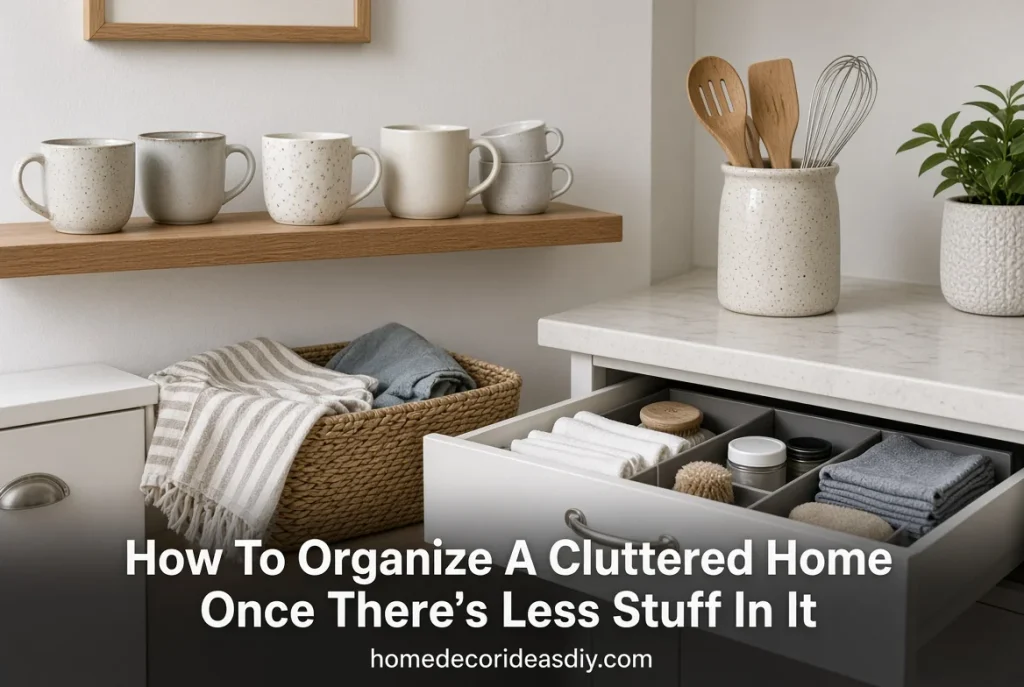
This is what people usually try first, and you’ll notice it’s a lot easier now that half the stuff is gone. Give every kind of thing one home, close to where you use it. Batteries go in the drawer you reach for when the remote dies. Spare towels go in the bathroom, and the extra paper towels can live under the kitchen sink.
The other idea from Dana K. White that I really like is treating every shelf and drawer as a container with a limit. If the mug shelf is full, it’s full, and that decides how many mugs you get to keep. You don’t need a rule with numbers in it because the shelf does it for you. It’s the same reason we like leaving a shelf empty on purpose when styling open shelves: a full shelf has no room for the next thing you bring home.
Now, add bins and baskets after you know what’s staying, and measure the space before you buy any. If your place is on the smaller side, our guide on how to organize a small house goes through it room by room, and most of that works for bigger homes too.
Clutter Comes Back To The Same Few Spots
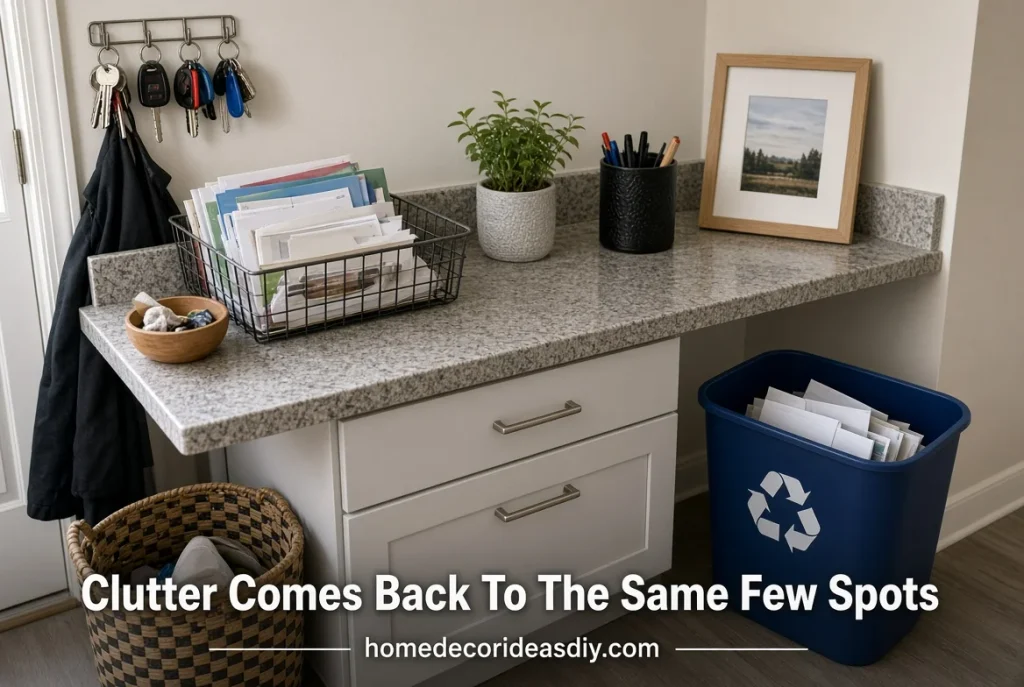
The last piece of organizing a cluttered home is keeping it that way, and it comes down to a handful of places. Once the house is clear, you’ll start to notice the mess doesn’t come back everywhere. It shows up in the same three or four spots over and over:
- The kitchen counter by the door. Mail, keys, bags, whatever’s in your hands when you walk in. Put up a hook for keys and an open mail stand next to the recycling bin, so the junk never even sits down.
- The dining table, which turns into a desk for paperwork if you eat somewhere else most nights. Clear it every night, even if the papers only go into one folder.
- The bottom of the stairs, where things wait to go up and somehow never do
- A bedroom chair that holds clothes you’ve worn once. Those either go back on a hanger or in the hamper before bed.
Should you clean on a timer every day? Some people love that. I’d put more effort into those few spots than into a whole-house routine you’ll probably drop by next month, because the spots are where the clutter starts.
Other People’s Stuff Is A Different Problem
Learning to organize a cluttered home gets harder when you share it with others. If you live with a partner or kids, a lot of the clutter isn’t yours, and you can’t really declutter someone else’s things for them. It usually backfires. Handle your own stuff first, keep the shared rooms clear, and give each person one basket for the things that pile up in common areas. Once a week, the basket goes back to their room, and what happens to it after that is their call.
With kids, keep it very simple. A toy bin they can reach, plus a rule that toys go in before dinner, works better than a fancy system with labels they can’t read yet.
A house doesn’t get this cluttered in a weekend, so I don’t think it gets fixed in one either. If the counters are clear and you know where your keys are, I’d call that a good start and leave the garage for another month.