Almost every guide to mirror home decor tells you where to hang the mirror. Very few of them tell you to go and stand on that spot first, turn around, and look hard at whatever is about to end up inside the glass. That’s the part that decides everything else. A mirror is basically a copy machine bolted to your wall. Aim it at a radiator, a door frame and a heap of shoes by the stairs, and congratulations — you now own two of those.
Took me an embarrassingly long time to work that out.
I had a round one up in the hallway for most of a year and kept blaming the frame, then the size, then the paint. It was reflecting the inside of a cupboard door. That was the whole problem. Moved it about four feet to the left, onto the wall facing the front window, and the hallway stopped feeling like a corridor.
Mirror home decor doesn’t add light; it copies what’s across from it.
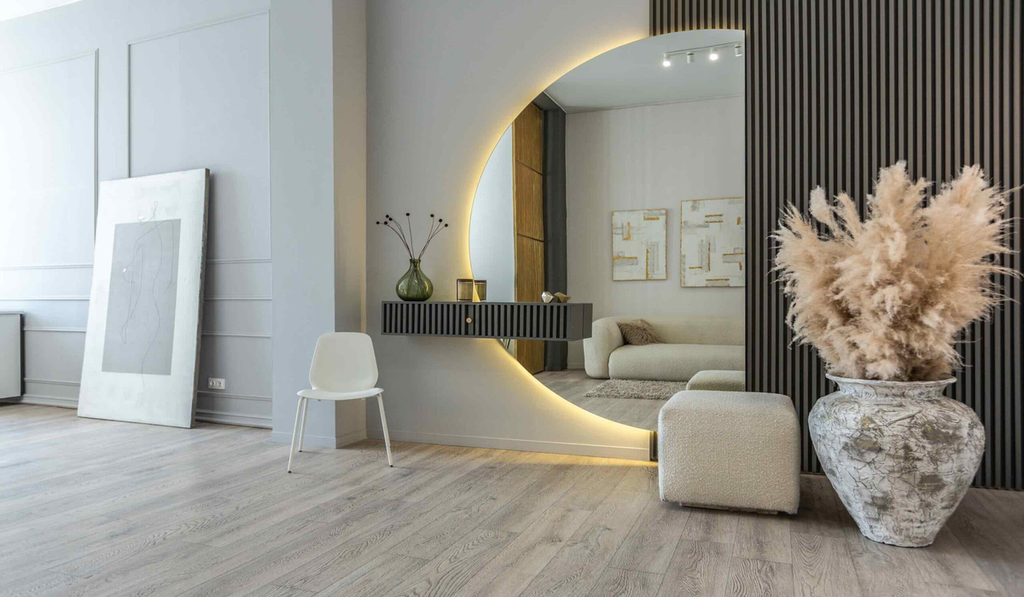
Mirrors don’t make light. They move it. As physicists explain, no new photons are created; the glass simply redirects illumination already in the room. So the total brightness stays exactly where it was—only the distribution changes.
That means the surface opposite your mirror does half the work, whether you think about it or not. The building research people at Level have measured how much light different surfaces send back, and the spread is wide: ceilings return up to 80 percent, walls somewhere between 50 and 70 percent, floors only 20 to 40 percent. Fresh white paint sits around 75 percent and drops as it yellows with age.
Read that back and the whole thing gets obvious. A mirror facing a pale wall with a window in it and a mirror facing a dark bookcase are not the same object. Same glass, same frame, same price. Completely different result, because one of them has something to copy and the other has a hole.
Hang it opposite a blank interior wall, and you’ve bought a grey rectangle.
So does a large wall mirror actually make a small room feel bigger?
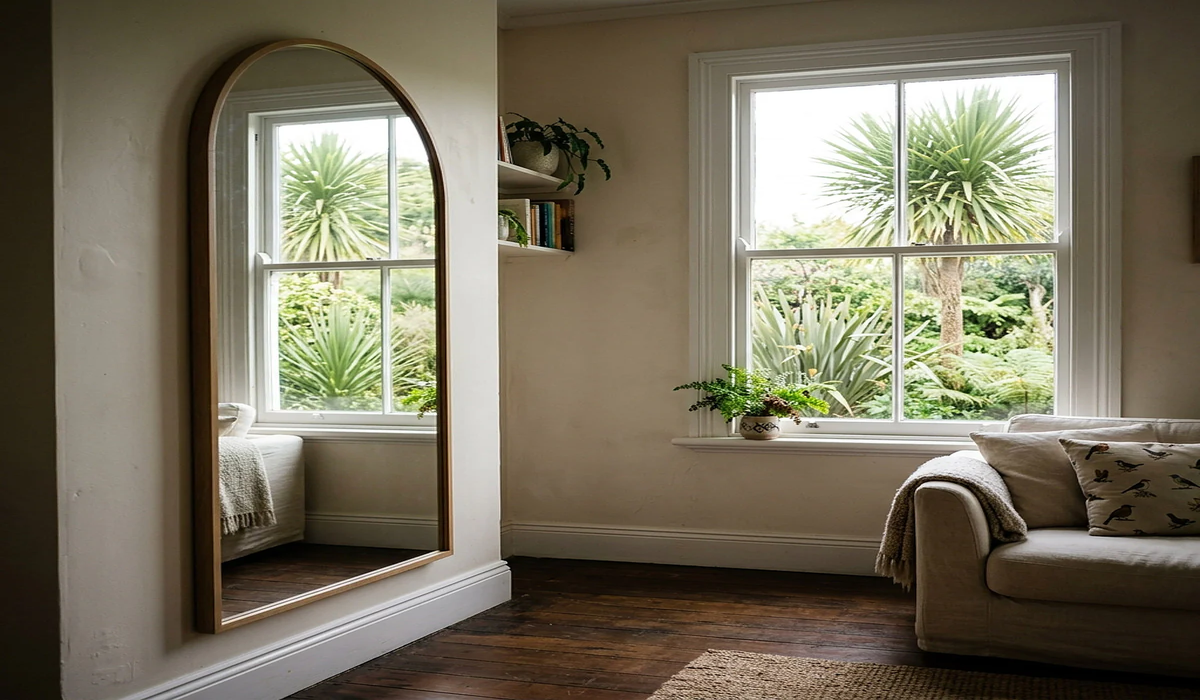
Only when the reflection contains depth, a mirror facing a wall three feet away reads as a window looking into nothing, and your eye clocks that as flat within about a second. A mirror facing down the length of the room, or into a window, or through an open doorway into the next room, reads as continuation. Your brain takes it as more house. Same object, same wall, and the difference was entirely what stood on the other side.
Stand where the mirror is going and look back at the room.
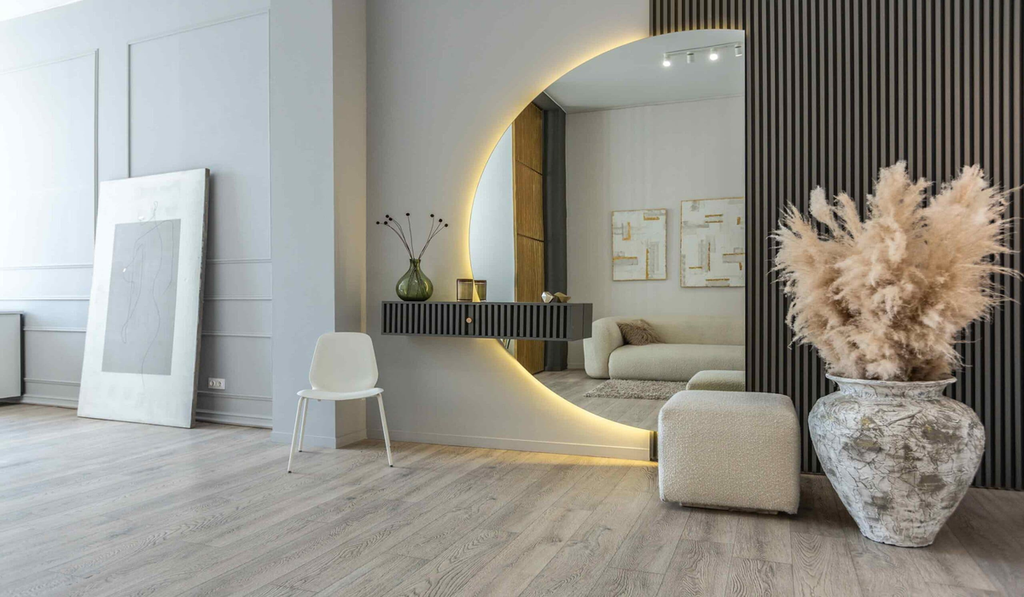
Cheapest test in decorating. Open the front camera, hold the phone flat against the wall at roughly the height you’re planning, and move it slowly along that wall. Whatever shows up on that screen is what you’re going to be looking at for the next five years, minus the frame.
Three things worth being honest about while you’re stood there:
- Is there a light source in it? A window, a lamp with the shade on, a doorway through to somewhere brighter. If none of those appear, move along the wall until one does.
- What colour and finish is the far surface? Pale and matte gives you back most of what hits it. Dark, glossy or cluttered gives you back a mess.
- What does it look like from the sofa? You’ll spend maybe ninety seconds a day standing in front of that mirror and several hours sitting across from it. Check the seated view, not the standing one.
Height is really a question of what slice of the room you’re copying.
You’ll see 57 to 60 inches to the centre quoted everywhere, borrowed from the way galleries hang paintings at average eye level. Fine as a starting point. But for a mirror, the number matters for a different reason, and it isn’t visual balance.
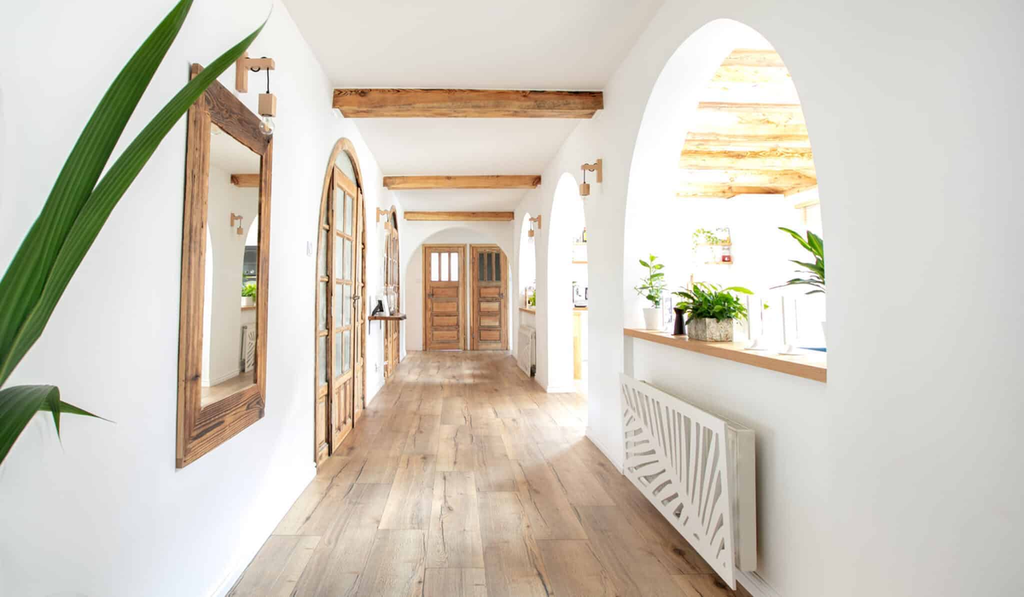
Height picks the angle. Angle picks which horizontal band of the opposite wall ends up inside the glass.
Hang it high, the way most people instinctively do, and you’re copying the ceiling and the top foot and a half of the far wall, which in almost every home is the emptiest, least interesting stretch of the entire room. Cornice, blank paint, maybe a curtain rail. That’s the reason too-high mirrors look strangely dead even when the placement is otherwise fine. People assume the proportions are off. The proportions are fine. It’s copying nothing.
Drop the centre to sixty and the same mirror starts picking up the window, the lamp, the doorway, the parts of the room that were worth doubling. Nothing about the wall changed. You changed what it could see.
Final Thoughts
Buy the wall before you buy the mirror. Sounds backwards, and it’s the one piece of advice I’d give anyone who asks, because the glass is a neutral object, and everything you’ll like or hate about it comes from the room opposite.
And if you’ve walked the whole space with your phone out and genuinely nothing on any far wall is worth doubling, take the hint and don’t buy one. Put a single showpiece or a piece of art there instead. Art brings its own content and doesn’t care what the rest of your room looks like, which is a lot to ask of a sheet of silvered glass. Most of the rooms that get called expensive were never spending more; they were choosing what to put opposite what