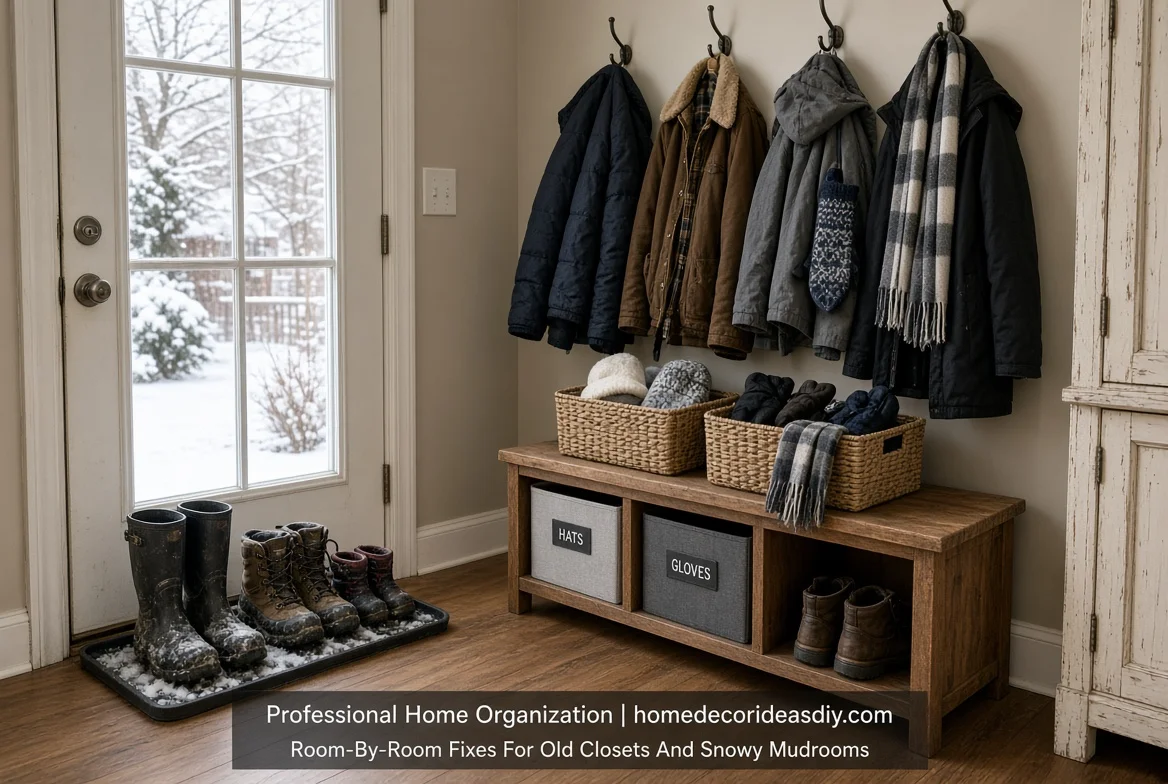
The first snow hits Downers Grove, and within about a day the back door is a mess. Boots dripping on the mat, one mitten drying on the radiator and the other one missing, a sledge somebody leaned against the dryer and forgot about.
I see some version of that in a lot of homes around here, and it’s rarely because the family is lazy. Usually the house was designed for a different century, or it’s a newer build with tons of square footage and no real plan for where anything goes.
So when people ask what professional home organization in Downers Grove, IL involves, my honest answer is that it’s mostly about fitting the system to the house and the weather. The pretty bins come at the very end, and sometimes they don’t come at all.
Why Downers Grove Homes Require Smart Storage Solutions
Part of it is the housing mix. Downers Grove, Illinois goes back to 1832, when Pierce Downer settled the area about 20 miles west of what’s now the Loop, and you can find a house from almost every decade since then within a few blocks of each other.
The older ones are charming, and they were also built for people who owned maybe a third of what we own now. The Downers Grove Museum has confirmed 68 Sears kit homes in the village, plus about twenty more from other catalog companies, and if you’ve been inside one you know the coat closet is about the size of a phone booth.
Then there’s the new construction. The village has had one of the highest teardown rates in the Chicago area, so many small, old houses got replaced with big open-plan homes, which sounds great for storage until you realize open plans mean fewer walls, and fewer walls mean fewer places for shelves and hooks.
The weather adds to all that. You need room for beach towels in July, and snow shovels and ice melt in January, often in the same garage, so storage around here has to shift with the seasons, and that idea runs through everything below.
Room-By-Room Professional Organization Techniques
I usually go room by room in this order, starting with the door your family uses most.
Entryways And Mudrooms
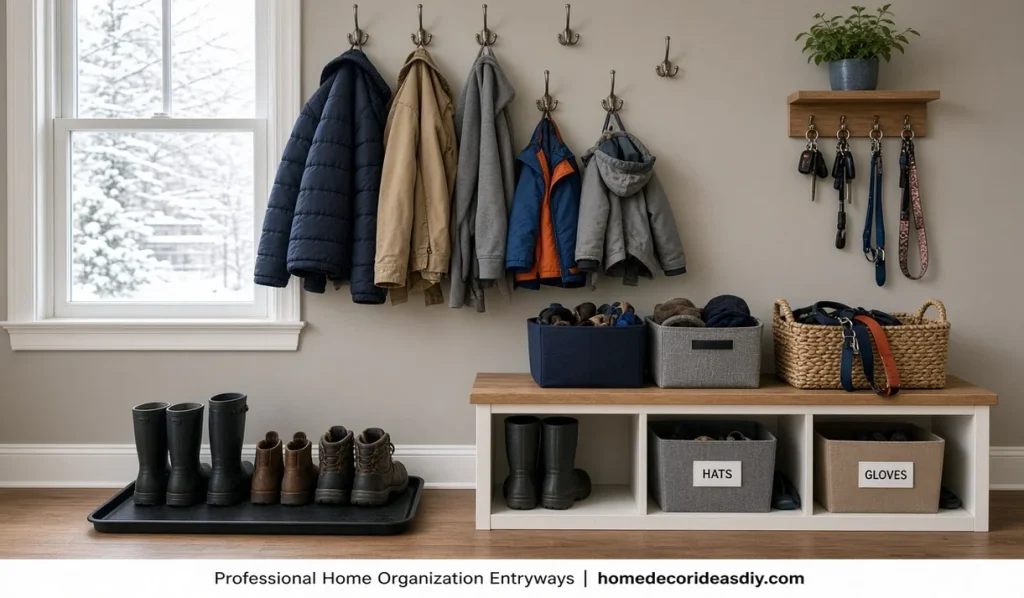
Salt, slush, and gravel start coming in around November and don’t really let up until March, so I almost always start in the entry.
The setup that works for most families is pretty basic: a boot tray or washable runner right inside the door, one hook per person hung at a height they can reach, and a small bin each for hats and gloves.
Kids especially need the low hooks. If a seven-year-old has to open a closet and find a hanger, that coat will end up on the floor every time.
A few other things help:
- a basket for keys, dog leashes and outgoing mail
- moving off-season gear out of the entry completely, since sunscreen doesn’t need to sit by the door in January
- a launch pad for anyone who catches the Metra at Main Street or Fairview, where the work bag, badge, umbrella and charger get set out the night before
No mudroom? Most older homes don’t have one. A narrow bench with cubbies along one wall gets you most of the way there, and if you’re thinking about something more built-in, our guide to Cabinets goes through what fits in tight spaces.
Kitchen And Pantry Decluttering
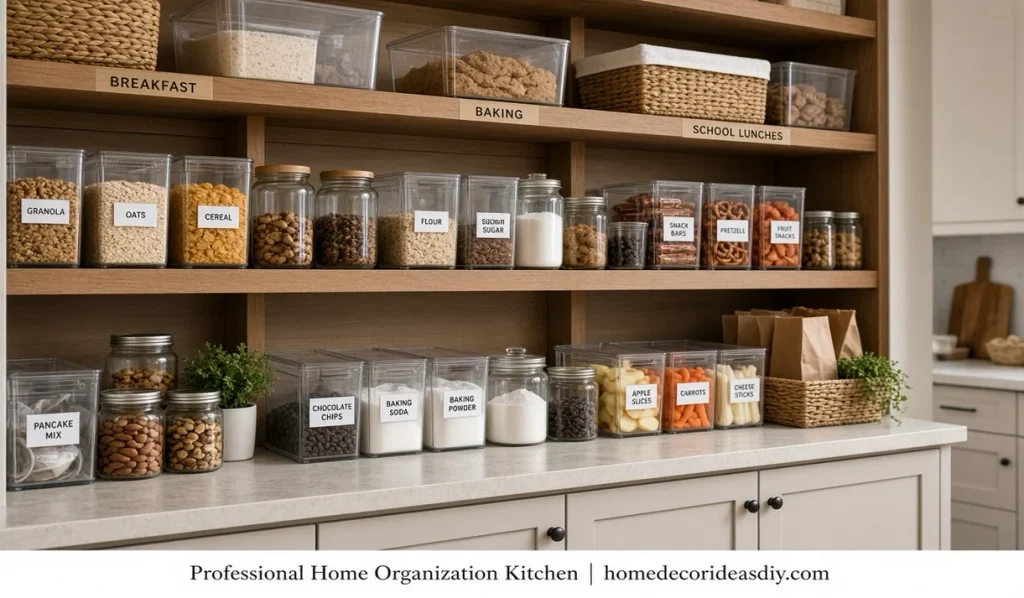
Empty one cabinet. Take just one cabinet and pull everything out onto the counter.
Then put things back based on how you cook instead of what category they’re in. Baking stuff goes together, breakfast stuff goes together, and everything for school lunches goes in one bin you can grab half asleep at 7 a.m.
While it’s all out, toss the expired spices and look for doubles, because almost every pantry I open has at least two of something (it’s weirdly often cinnamon). Clear bins on the deep shelves keep things from getting lost in the back, and if you do the warehouse-club thing, keep the backups in the basement with only one open package upstairs.
Closet And Bedroom Space Maximization

Bedrooms in older houses tend to have one small closet, sometimes tucked under a sloped ceiling, and newer walk-ins fill up just as fast.
Either way the fix is to build up before you buy more furniture. A second hanging rod for shirts and kids’ clothes, another shelf above the existing one and hooks on the back of the door for bags and robes can nearly double what a small closet holds.
Then rotate. Put sweaters and heavy coats in bins in spring and summer, then switch to those same bins for fall clothes, so the closet holds only one season. Under-bed bins help too, and if a dresser or nightstand isn’t pulling its weight, it might be worth reworking rather than replacing, which is what our DIY Furniture is all about
Basement And Attic Seasonal Rotation
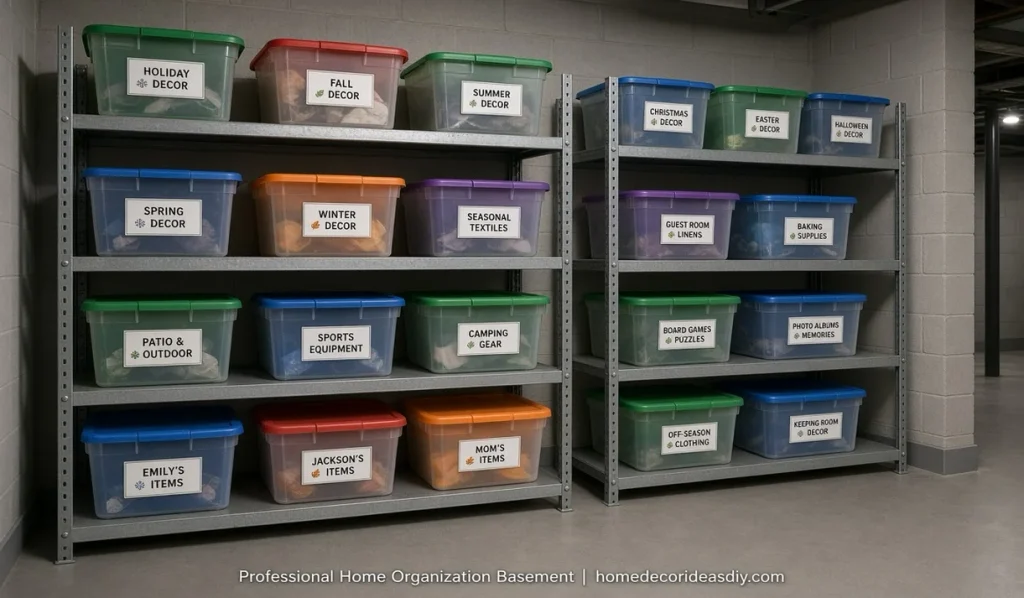
This is the part of a Midwest house that either works well or turns into one giant pile of snow gear, holiday boxes, camping chairs and pool floats.
The first rule is to get everything off the floor. Use metal or plastic shelving and lidded plastic bins, and avoid cardboard, because cardboard soaks up basement moisture and then ruins whatever’s inside.
After that it’s mostly labels and rotation:
- Label by season and by person. “Winter, Sam” is a lot more useful than “misc.”
- Keep whatever season you’re in at the front. Around October,, the coats, boots, and snow pants come forward, and the summer stuff moves to the back.
- Put a donation bin at the bottom of the stairs so outgrown things go straight in instead of back on a shelf.
Colored lids are worth the extra few dollars. Use red for holidays, blue for winter, green for camping, and you won’t have to open six bins to find the tree stand.
One more thing on attics: they get really hot in summer, so candles, old photos and anything with batteries should live somewhere else.
DIY Vs Hiring Professional Organizers In DuPage County
Plenty of homes don’t need to hire anyone. They need a free Saturday, a box of contractor bags, and some honesty about what they’re using.
These are the going rates in the Chicago area right now:
| Option | Typical Cost | Best For |
| Do it yourself | Your time, plus bins and shelving | One room at a time, motivated households |
| General help through Taskrabbit | About $41 an hour on average in Chicago | Lifting, assembly, hauling donations |
| Professional organizer | $60 to $175 an hour, with most projects running $327 to $981, per Angi | Whole-house resets, moves, downsizing |
A pro is usually worth the money when the hard part is deciding what stays and the carrying is the easy bit. If you’ve been moving the same piles from room to room for months, an outside person can get you unstuck surprisingly fast.
If you do hire someone, ask three things before booking: whether they offer a free phone consult, whether they bill for time spent shopping for bins, and whether they’re a member of NAPO, the National Association of Productivity & Organizing Professionals.
Going the DIY route? This is the order I’d tackle it in:
- The entry, since everyone uses it every day.
- The kitchen, because you’ll feel the difference fastest there.
- Bedrooms and closets, doing the seasonal swap as you go.
- The basement or garage last, once you’ve got a routine for donating and trash.
- Getting it all out of the house that same week. The Goodwill donation centre at 110 Ogden Ave. takes clothes and housewares; Republic Services picks up two bulk items a week at the curb; and old electronics and household chemicals go to Naperville’s Environmental Collection Campus on Fort Hill Drive, which serves DuPage County residents.
Practical Maintenance Habits To Keep Your Space Clutter-Free
The organizing itself is usually one big weekend. What keeps it that way afterwards is a handful of small, honestly boring habits.
The one I push hardest is a ten-minute reset every evening, where everybody in the house puts back ten minutes’ worth of stuff before bed. Set a timer if you have to. It’s also the habit people drop first, and the one they miss most by February.
A few others that tend to stick:
- one in, one out, so a new pair of boots means an old pair goes in the donate bin
- two calendar reminders a year for the season swap, one around the first frost and one around Memorial Day
- a single tray for mail, sorted on the same day every week
- a “maybe” box with the date written on top, which goes to Goodwill unopened if you haven’t needed anything from it in six months
Start With One Drawer This Weekend
Your house doesn’t have to look like a magazine spread. It just has to work for your family, the Illinois weather and the way your rooms were built, whether that’s a 1920s kit home or a brand-new rebuild.
So pick one drawer or one shelf this weekend and start there. It’s a small thing, but it tends to snowball, especially once you get the back door under control again.
If you’ve got a trick that keeps your house sane through a Chicago-area winter, leave it in the comments. I’m always happy to steal a good idea.