My sister sat on mine at a birthday thing last month, and her knees came up level with her chest, and she gave me a look I’m still thinking about. The mushroom stool had been sitting in the corner of the living room for about three weeks by then. Cream bouclé cap, short pale stem, exactly as cute as the photo that made me buy it. What it is not, and this took me longer to work out than I’d like to admit, is a seat.
The odd part is that the listing never lied. The number was printed right there in the specs. I just read it as a design detail instead of a warning.
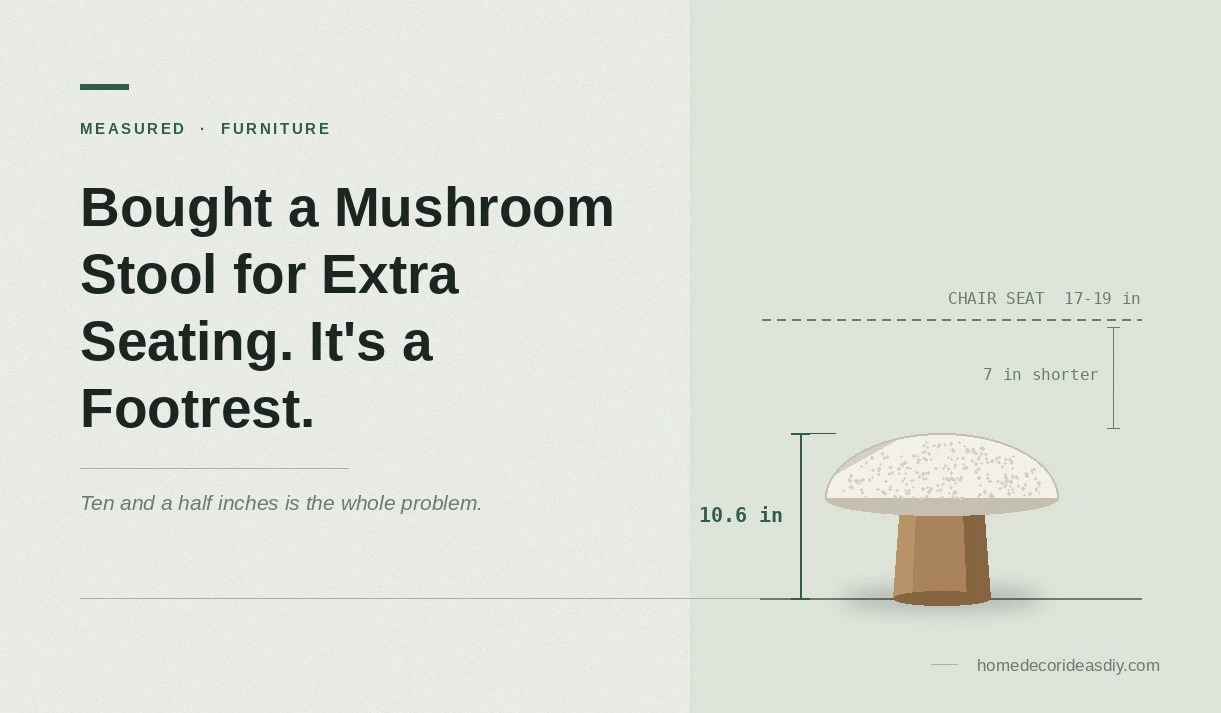
Ten and a half inches is footrest height
Scroll through the mass-market mushroom footstool listings, and the same figure keeps turning up: 10.6 inches tall. Sellers describe that as an ergonomically comfortable height, which it is, for feet.
Compare it against the rest of your room:
- Dining chair seat: 17 to 19 inches
- Sofa seat: 16 to 18 inches
- Typical mushroom footstool: 10.6 inches
- Fiberglass mushroom side table versions: around 17.7 inches
So an adult sitting on one is parked six or seven inches below every other person in the room, hip below knee, no way to stand up without a small production. Kids are fine. Kids love them. Adults do the knee thing and shuffle off to the sofa after four minutes.
Weight isn’t what’s failing here, which surprised me. Upholstered ones are usually built on a solid wood frame with high-density foam and rated for 200 to 250 pounds, some with a 360-degree swivel. The Fuji ottoman from Jennifer Taylor Home, one of the more common bouclé versions, runs 15 inches across the cap and takes 200 pounds. Plenty of load. Wrong altitude. And the reviews say it plainly, over and over, in that slightly deflated way people write when something is lovely and useless: very small, truly a footstool, not a seat.
The cap is wider than the base, so it extends out to the sides.
Sit on the middle, and it holds. Sit on the edge, and your weight lands outside the footprint of the stem, and physics does what physics does. Cap diameters run 15 to 18 inches on most of these. The stem underneath is often half that, sometimes less, occasionally a three-pillar base which is better but still narrow.
Before you buy one, three things worth measuring:
- Base footprint, not cap diameter. If the base is under half the cap width, it’s decorative seating.
- What the stem is actually made of. Wood frame, plastic drum, cardboard tube, a molded fiberglass shell, MgO for the outdoor ones. Listings bury this.
- Total height against the seat you’ll put it near. A reviewer of one of the fiberglass mushroom side tables put it well: it only works if the rest of your furniture is low.
Pierre Paulin solved this in 1960 and gave it a real seat height.
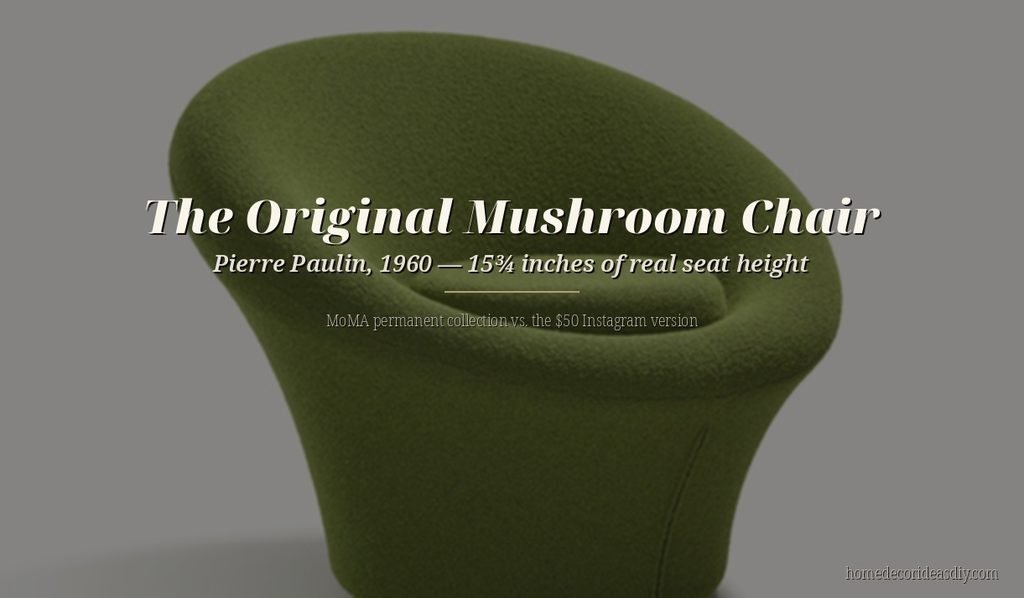
The shape isn’t a TikTok invention. Pierre Paulin drew the Mushroom for Artifort in 1960, and the Museum of Modern Art holds it in the permanent collection as Mushroom Chair model 560: tubular steel frame, latex foam, stretch fabric, seat height 15¾ inches. Nearly sixteen. Not ten and a half. Paulin was designing something you sat in, and the whole point of the curve was that it wrapped a person.
Artifort’s account of where the idea came from is that Paulin was looking at women in one-piece swimsuits and wanted that seamless stretched skin for a chair, which is either charming or very 1960, and I’ve never quite decided. The construction method that came out of it, a single stretch cover with no seams, changed how upholstered furniture got built. That’s the ancestor of the fifty-dollar stool going round Instagram. Something got lost in the descent, and mostly it was inches.
The current wave is retro revival more than fungi. Curved organic shapes after a long stretch of hard minimalist edges, cottagecore and weirdcore feeding it, and a price point low enough that people try the trend without committing to it. That last bit is really why they sell.
So what is a mushroom stool actually good for?
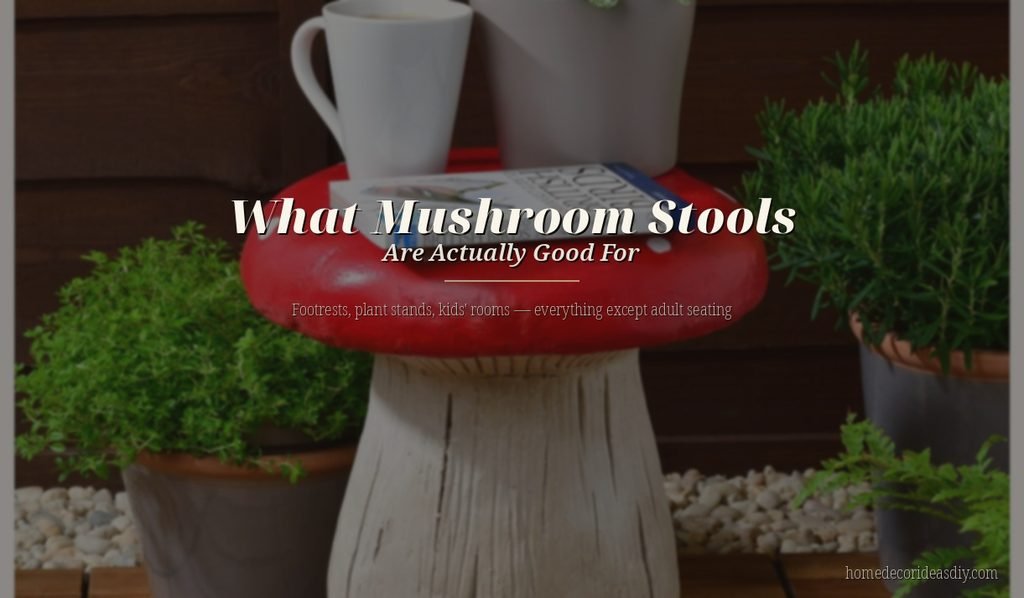
Everything except adult seating, honestly, and it’s better at those jobs than the thing you’d otherwise buy. Under a desk it beats a shoebox for footrest duty by a wide margin. In a kid’s room it’s genuinely the right height, which is the one context where the proportions were never wrong.
The uses that work:
- Plant stand. A wide flat cap holds a big pot better than most plant stands do, and the height flatters a trailing plant. Worth pairing with a container that isn’t a nursery pot, which is a whole separate problem I’ve written about in home decor pots.
- Shoe-changing seat by the door, where being low is the point.
- Side table, if you go for the fiberglass or MgO versions rather than upholstered, and if the sofa next to it is low.
- Vanity stool, though only with a taller stem.
What it isn’t is the extra chair you pull out when six people show up.
Building one you can sit on
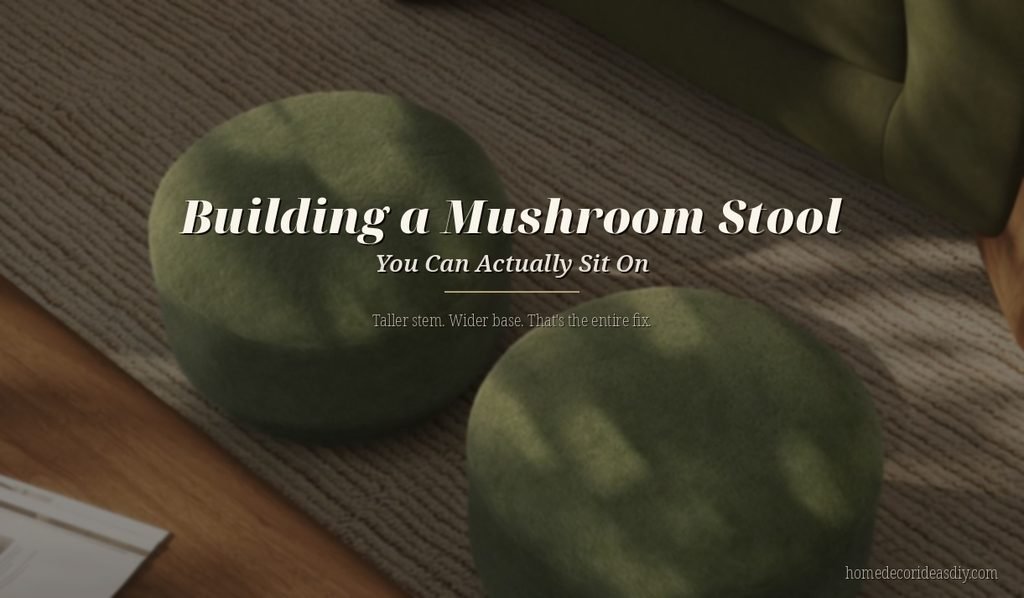
The fix is boring. Make the stem taller and the base wider. That’s the entire difference between a decorative object and a working mushroom stool. Every DIY tutorial I’ve read solves the cap beautifully and treats the base as an afterthought, which is exactly backward.
The base decides everything.
Popular options, roughly in order of how much I’d trust them under an adult:
- 4×4 post section, cut to length, screwed through the cap with pilot holes drilled first. Solid. Ugly until you paint it.
- Concrete tube form (Monotube style), cut to around 11 inches, filled or reinforced. Heavy, stable, awkward to move.
- Terracotta or resin planter, inverted. Bolt it, don’t glue it.
- A five-dollar bucket, which is the Hunker method, padded with half-inch foam to smooth the ribs and covered. Fine for feet, fine for a child, and I wouldn’t sit an adult on it.
If you want an actual seat, cut the stem to 15 or 16 inches and make sure the base is at least two-thirds of the cap width. A 13-inch cap on a 9-inch base is stable. An 18-inch cap on a 6-inch base is a trap.
The cap is the easy part.
An 18-inch plywood or melamine round, two-inch foam glued on with spray adhesive, a smaller foam circle on top, and scraps filling the gap between them to build the dome, then batting, then fabric, stapled underneath with quarter-inch staples. Half-inch melamine-coated plywood is the nicer choice because the finished underside doesn’t need hiding.
Bolt it, don’t glue it.
Drill a quarter-inch hole through the center of the cap and the center of the base, run a 2.5-inch hex bolt through with washers on both sides, and put a second nut on to lock it. Hot glue will hold a mushroom ottoman together right up until someone sits on the edge of it, at which point you’ll find out.
One warning on kits. Somebody who ordered an unstuffed mushroom cover reported being told it needed 6.5 pounds of filling and finding that 10 pounds was the actual number, and it could have taken more. Whatever the pattern says, buy more stuffing than that. Underfilled caps sag in the center, and then the whole thing reads homemade in the bad way.
If you’d rather not build, the handmade market has better proportions than the mass-market drop-shippers do, though it costs more and takes longer, and telling the real makers from the resellers is its own skill. I went into that with handmade home decor items.
Buy the store version if you want a footrest or a plant perch, and be honest with yourself that’s what you’re buying. Build it if you want a seat, because at ten and a half inches there is no fabric good enough to rescue that height. Mine is still in the corner, still cream, still holding a fern now instead of a guest, and it looks better doing that than it ever did pretending to be furniture.