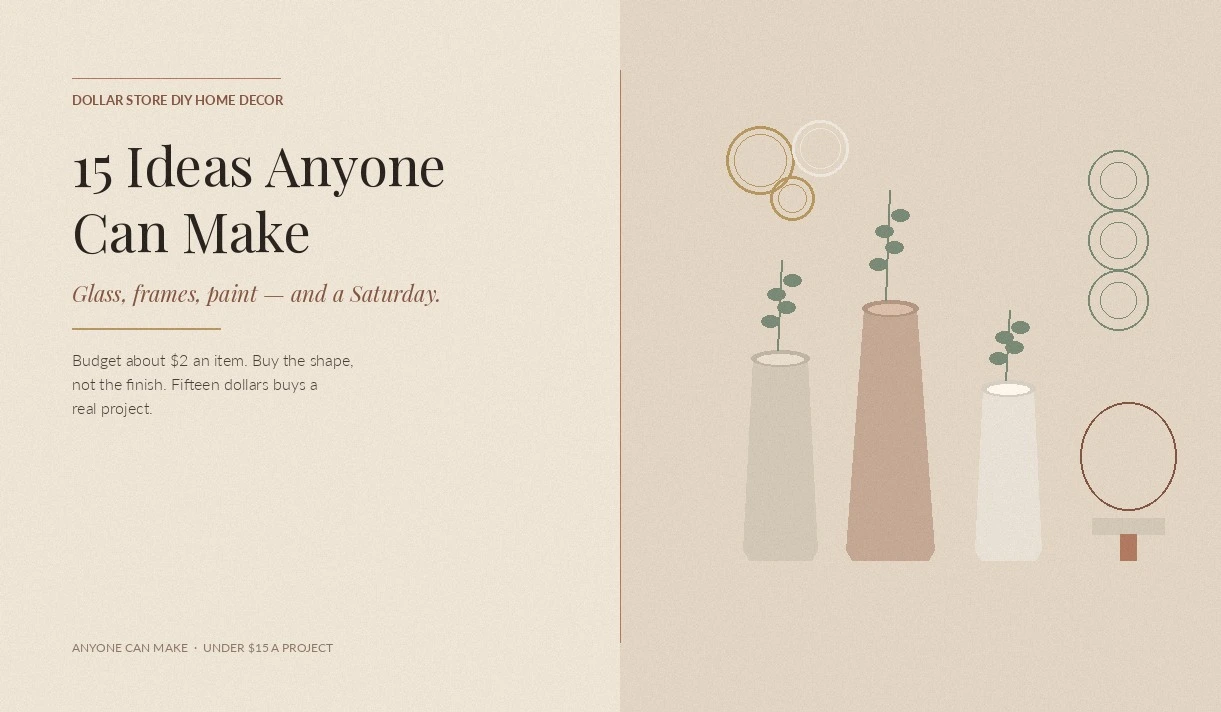
Four glass cylinder vases, a bag of felt pads, and a can of flat white paint that was already sitting in my garage. Under eight dollars that Saturday, and two of those vases are still on my mantel getting asked about by people who assume I paid real money for them. That is the whole argument for dollar store DIY home decor, and I am not going to sit here and tell you every shelf in that store is worth your time, because a lot of it isn’t. The useful stuff lives in about four aisles. Everything else is a trap you buy on the way to the register.
A dollar store is not a dollar store anymore
Worth knowing before you plan a budget around it. Dollar Tree held a flat dollar for thirty-five years, then moved its base price to $1.25 back in 2021, and it has kept drifting since. Multi-price racks now run $3, $5, and in some stores up to $7. The company still says roughly 85% of its opening price range sits at $2 or under, which is what matters for craft supplies. Glass, frames, faux stems, baskets, brushes, contact paper. All still cheap.
So budget $2 per item, and you will rarely be caught out. Fifteen dollars gets you a real project. Thirty gets you a whole shelf redone.
If you want the tier above this, where things start actually lasting, I went through home decor items under $200 that are worth buying separately, because there is a point where cheap stops being clever.
The glass aisle does most of the work.
This is the aisle I hit first every single time. Plain glass is the one thing dollar stores genuinely do well, because it’s cheap to make and hard to make badly.
1. Textured stone vases from plain glass cylinders
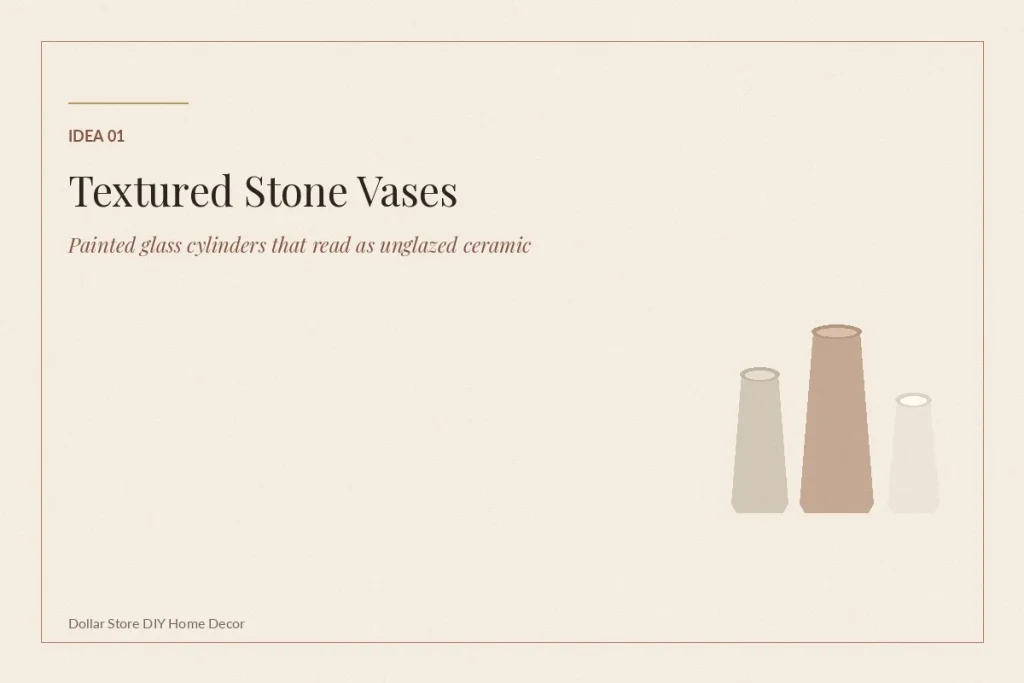
Mix about two tablespoons of baking soda into a quarter cup of flat craft paint, stir it until it looks like thin porridge, and brush it onto a glass cylinder in two coats. Let the first dry properly before the second, and I mean properly, not the fifteen minutes you think you can get away with. What comes out looks like unglazed ceramic. Warm white and a dusty clay color both work. Black works if the room can take it.
Check the mouth of the vase before you buy it, because a vase with an opening wider than the stems you own is a vase that sits empty forever. I got obsessive about this and measured fourteen vase openings to prove the point to myself.
2. Cake stand plus glass bowl equals a cloche
Buy a small glass cake stand and a bowl with roughly the same diameter, flip the bowl over the stand, and you have a display dome for about $2.50. Put something small and odd under it. A shell, a stack of three matchboxes, an old watch. This works because a dome tells everyone the object matters, and half of decorating is just telling people what to look at.

3. Jar lanterns, but with LED tealights only
Wrap a jar in twine or tape a stencil on and mist it with frosted glass spray. Fine. Cheap. Looks good on a porch step in a group of five.
Here is the part most tutorials skip, though. Don’t put a real flame in dollar-store glass. Candle jars sold for burning are annealed and tested for thermal shock under ASTM standards, and the National Candle Association publishes those standards for a reason. A thin decorative jar has not been through any of that. It cracks. I have had one go on a windowsill, and it was not a small mess. Battery tealights cost about a dollar for a pack of four, and nobody can tell from across a room.
Five wall ideas that come in under ten dollars
Walls are where dollar-store stuff punches hardest, because on a wall what reads is shape and repetition, not material quality. Nobody walks up to a wall and taps it.
4. Charger plate cluster. Gold or matte white chargers, five or seven of them, hung in an uneven cluster with adhesive plate hangers odd numbers. Vary the sizes if the store has two sizes. From six feet away, this reads as a collection of ceramic, which it very much is not.
5. Woven placemat discs: the round seagrass ones. Hang three in a vertical line down a narrow bit of wall, the sort of awkward strip next to a door that never has anything on it. Costs about four dollars and fills a gap that would otherwise need a $60 piece of art.
6. The oversize mat trick. This is the one I push on everyone. Buy an 8×10 frame, buy a sheet of thick white cardstock or a plain mat board, cut an opening in the middle that is much smaller than the frame, and drop a 4×6 print into that opening. All that empty white margin is what gallery framing actually costs money for. A small picture floating in a lot of white space looks deliberate. A small picture in a small frame looks like a fridge magnet.

7. Mirror sunburst. Small round mirrors, the kind sold in packs for craft use, arranged around a central point in a rough sunburst. Cheap, and it throws light around a dark hallway. Before you commit to the spot, stand where you plan to hang it and turn around, because a mirror’s whole job is to reflect the opposite wall, and most people never check what that reflection contains.
8. Clipboards as a rotating gallery. Six clipboards in a grid, one nail each. Swap the paper whenever you feel like it. Kids’ drawings, a calendar page, a torn magazine spread. It is the only wall display I have that I actually change, and that is because changing it takes four seconds instead of a screwdriver.
Dollar store DIY home décor that lives on a shelf
Shelves are harder than walls. On a wall you get distance. On a shelf, someone picks the thing up.
9. Aged terracotta pots. Dollar store terracotta comes out orange and shiny in a way real terracotta never is. Water down some white or grey acrylic, brush it on loose, then wipe most of it back off with a rag while it is still wet. Aim for uneven, patchy, and a bit dirty-looking. Do it to four pots at once because they look better in a group than alone, and if the pot is holding a live plant, pick the pot around the plant’s needs rather than the other way round.

10. Tear the faux stems apart. Nine out of ten dollar store faux stems look plastic because the manufacturer stuck three sad leaves on a wire and called it a plant. So buy five of them, strip every leaf off the stems, and rebuild one dense arrangement out of all that material. Density is what makes fake greenery convincing. One thin stem in a vase reads as fake instantly. Fifteen leaves crammed into a small opening reads as a plant somebody has been keeping alive.
Real ones are still better if your window can support them, and window light is genuinely the whole game with choosing plants for a room.
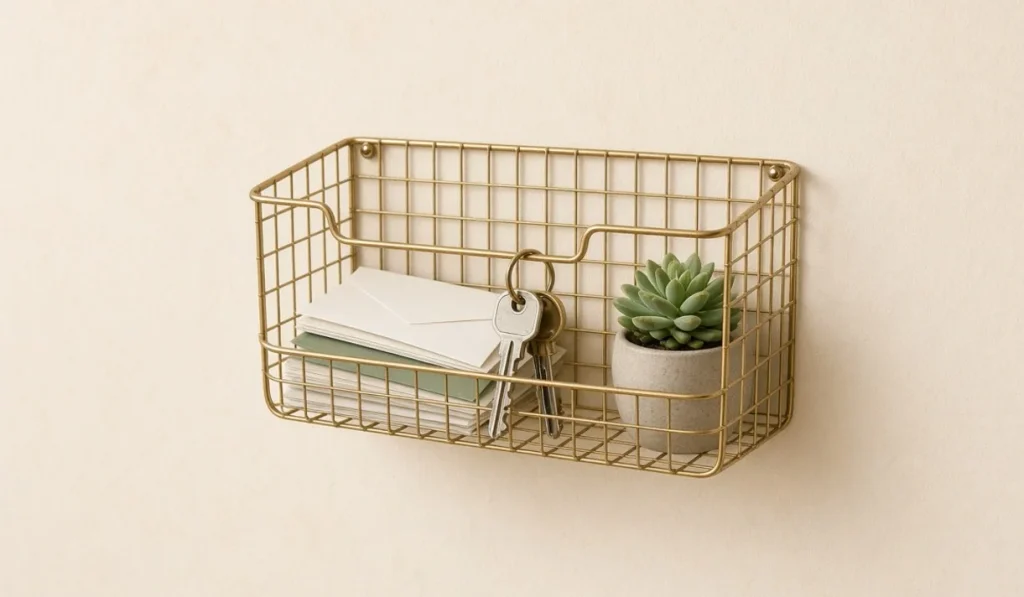
11. Wire baskets, mounted sideways. Take a small wire basket, turn it so the opening faces out, and screw it to the wall. Now it is a shelf with a lip. Mail, keys, a small plant, whatever. Two dollars.
12. The tray upgrade. A plastic serving tray, sanded lightly, sprayed matte black, then a rectangle of nice fabric or wrapping paper cut to fit the base. Sanding is the step everyone skips, and it decides whether the paint stays on. Thirty seconds with a bit of sandpaper. Do it.
The three that take actual effort
I would not call any of these hard, but they take an afternoon rather than ten minutes, and two of them need a drill.
13. Wooden crate side table. Two crates, stacked with the openings facing out in opposite directions, screwed together at the join, and four cheap furniture feet on the bottom. Stain it or paint it. It comes out at roughly $12, and it holds a lamp, a book, and a mug without complaint. The feet are what sell it, because a box on the floor looks like a box on the floor.
14. Contact paper on the wrong surfaces. Everyone uses it in drawers. Use it on drawer fronts instead, or the sides of a bookcase, or a single strip behind a kitchen sink as a fake backsplash. Wipe the surface with rubbing alcohol first and let it dry; otherwise it will lift at a corner in about a week, and then you will be picking at it every time you walk past. Marble and plain-color rolls hold up better than anything trying to imitate wood grain.

15. Dowel and hook blanket rail. A wooden dowel, two large hooks or cup hooks screwed into the wall about three feet apart, dowel resting across them. Drape a quilt or a couple of throws over it. That is the whole build. It reads as intentional in a way that a folded blanket on a chair never quite does, and it took me about fifteen minutes, including finding the drill.
What I stopped buying there
Because you should know where the floor is.
- Anything with a printed word on it. The signs, the “Live Laugh” wood plaques, the printed canvases. There is no rescuing them.
- Faux flowers with visible plastic stems. Leaves you can strip and reuse. A molded plastic rose is molded plastic forever.
- Picture frames larger than 8×10. The backing board is too thin and the glass, where there even is glass, bows.
- Anything battery-powered that is not a tealight. The fairy lights die in a month. Ask me how I know.
- Storage bins. They crack at the handle—every time.
There is also a decent argument that for a few dollars more you do better at a flea market than a dollar store, and honestly, on furniture and anything wooden I think that is true. I have picked up better pieces at US decor markets for eight dollars than anything the craft aisle can produce.
But for glass, for frames, for the raw material you are going to paint over anyway, the dollar store still wins, and it isn’t close. The rule I go by is simple enough. Buy the shape, not the finish. If the shape is right and the finish is bad, that is a project. If the shape is wrong, no amount of paint will fix it, and you will have wasted a Saturday finding out.